Technical.ly is a free news resource thanks to financial supporters like Tech Council of Delaware, a Technical.ly partner, which sponsored this article. It was reviewed before publication. Learn more about Tech Council of Delaware here.
AI disruption in the workplace is more complicated than headlines suggest.
Delaware’s economy is growing, but that growth no longer automatically creates jobs. That’s because AI is automating tasks and dramatically changing which skills jobs require, and it’s doing it faster than workforce systems were built to handle. For states that move strategically, it presents a great opportunity. For states that don’t, it’s a slow-moving crisis.
Delaware is at a crossroads. The state has all the ingredients to lead this workforce movement, but the leaders — the ones building this ecosystem from the inside — say what’s needed is more than independently moving parts. Delaware needs a proactive strategy.
“We know AI will impact Delaware’s workforce. The question is whether we build the infrastructure before it does, and whether we have a strong enough organization in place to coordinate the response for the entire state,” said Joshua Berkow, CEO of the Tech Council of Delaware.
The scale of the AI workforce opportunity
Delaware has over 500,000 residents in our workforce. Nearly half the state’s AI job demand comes from roles outside the traditional IT industry, including engineers, healthcare workers, financial professionals, creatives, administrators and tradespeople.
AI will impact virtually all of them, whether through required proficiency or basic literacy. That’s the scale of this challenge.
Delaware ranks No. 2 nationally for AI demand, according to Lightcast, just behind Washington DC, with 4.5% of job postings requiring AI skills versus the 2.5% national average. AI hiring in Delaware is up over 50% since 2024 — and because job posting data is inherently lagging, the 2026 reality on the ground is likely even more pronounced. Professionals need training, and employers need to find them quickly.
The pieces are here: the state’s AI Training subcommittee; outstanding training programs like Zip Code Wilmington, Code Differently and Tech Impact; the University of Delaware’s First State AI Institute; new federal grants coming online to organize a statewide AI response. They just aren’t connected yet.
“Not enough Delaware residents realize they could be sixteen weeks away from a $65,000 job with benefits,” Berkow said. “These programs are producing real, life-changing results, but we need to create more public awareness, and make sure more employers are connected to the talent coming out of them.”
Employer needs are a driving factor
33% of skills in the average Delaware job description shifted between 2021 and 2024, and the pace of change is not slowing down.
Rich Jester, secretary of Delaware’s AI Commission and a tech leader at JPMorganChase, has seen the employer and professional sides of this challenge. He sees AI as a tool that, properly implemented at scale, optimizes processes and enhances employee strengths, rather than replaces people.
The best AI systems, Jester believes, are custom-fit and consistently trained by people on the job.
“The true goal of AI is to look at specific processes, capture data, find out if it’s optimized, then use AI to save time, money and resources. Or identify where you might be better off to outsource,” Jester said.
While there is not yet clear evidence of mass AI-driven layoffs in Delaware, AI is already changing how work gets done. Workers need the foundational skills to stay relevant as those shifts accelerate, just as employers need to be clear on their upskilling and hiring needs.
Lucas Levine, chief commercial officer at FutureFit AI, a national workforce platform built to move more people into better jobs, faster, at lower cost, has seen this pattern across multiple states.
“A lot of employers have no idea what they need right now,” Levine said. “And workforce systems are designed for linear pathways like the four-year degree to an entry-level job. As AI is disrupting dozens of industries at once, what we do know is our systems are too rigid.”
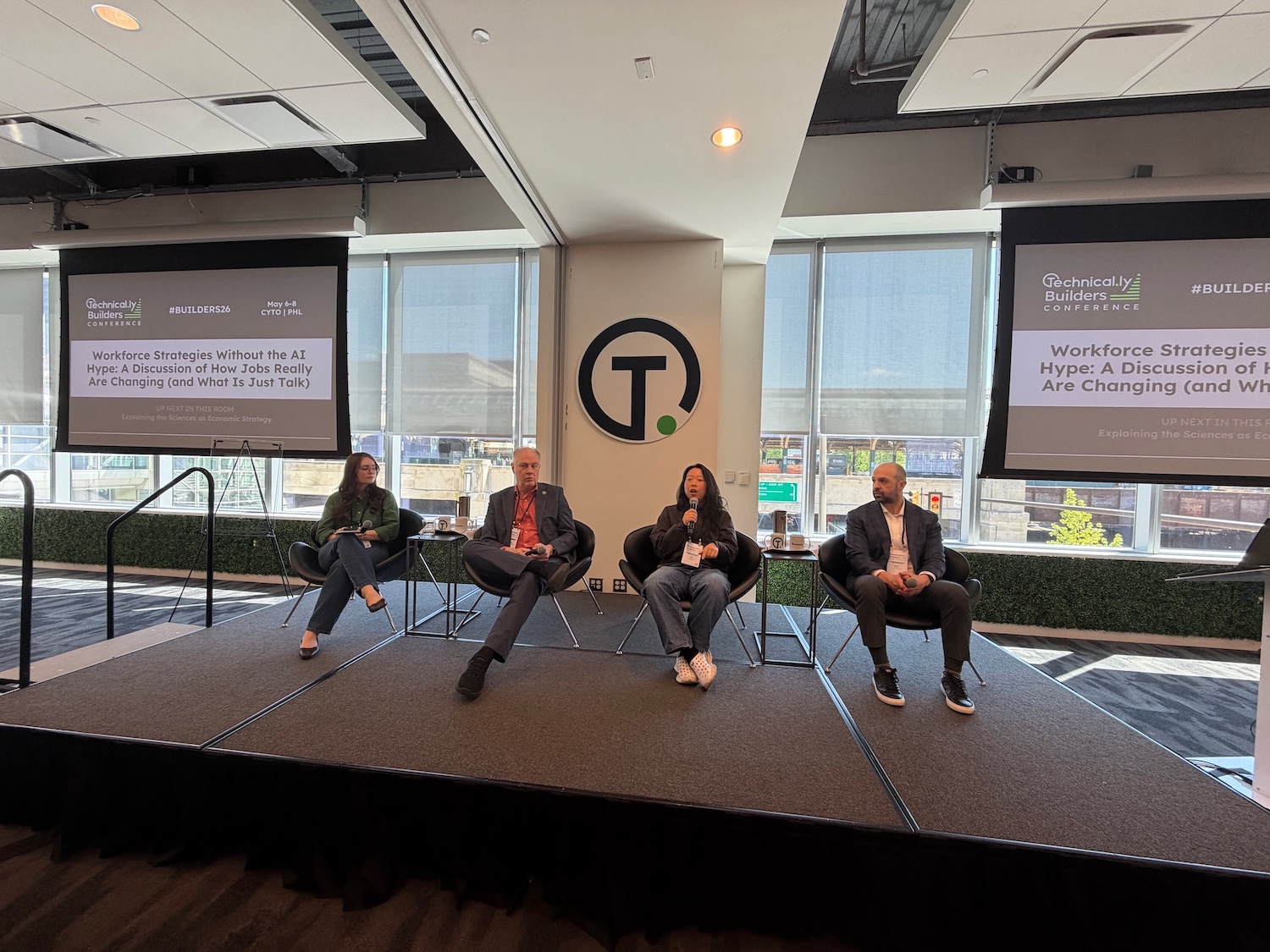
The platform and the proof
Rapidly changing employer needs require solutions that can flex with the times.
That’s what drove the partnership between the Tech Council and FutureFit AI. The platform connects job seekers, employers and training providers in a single ecosystem — assessing skills, navigating individuals toward relevant programs and connecting graduates to real opportunities.
In Connecticut, a comparable small northeastern state, a similar FutureFit AI partnership produced over 50,000 registrants and more than 7,000 job placements, many with no prior experience in their new field.
Trust is what makes these partnerships work. “We’ve started to think about trust more as a currency, a capital resource organizations have to actively cultivate.” said AJ Temple, FutureFit AI director of policy and partnerships.
“The Tech Council has that foundation of trust,” agreed Levine. “We see them as the quarterbacks for a workforce ecosystem.”
Through a proposed partnership anchored by the Aspen Institute’s WIN AI grant focused on AI upskilling for women, the Tech Council would serve as the operational backbone of an AI Navigator platform for Delaware. It would aggregate training programs, match residents to opportunities aligned with their skills and goals and give employers a direct line to a qualified, AI-proficient talent pipeline.
Because the platform adapts as employer needs evolve, it can expand to meet new needs as they rapidly arise.
The Tech Council as Delaware’s AI workforce connector
The applications a trained Delaware workforce could build are already being imagined.
Sunita Chandrasekaran, director of the University of Delaware’s First State AI Institute, describes a digital twin of a Delaware coastal town — a virtual replica where evacuation routes and flood infrastructure can be tested before real-world decisions are made. With Nemours just up the road, imagine a digital twin of a cancer patient, where treatment pathways can be simulated before a person endures months of trial and error.
“I can’t imagine doing this in another state. Where else can you run into a senator’s office and have a conversation to make a difference at that level?” Chandrasekaran said.
Actualizing that future requires a workforce trained to build and run it. Delaware has the relationships. What it needs is an organization to connect them.
The Tech Council is where all the moving pieces find their place.
“We’re here to move the entire tech workforce system in the same direction. To understand what employers are hiring for, connect training providers to that demand and make sure every dollar from state, federal or philanthropic sources gets coordinated toward a real outcome,” Berkow said.
The dollars are available. The National Science Foundation has issued a solicitation for statewide AI coordination hubs. Grant-makers want to see coordinated efforts, established partnerships between organizations and a clear governing structure in place before they deploy funds.
The states that lead in AI workforce development will be those that build connected, employer-aligned infrastructure ahead of the disruption. The Tech Council has already established trust, knowledge, connections and partnerships across the tech ecosystem. It’s positioned to be the organization that brings all the employers, funding opportunities, policymakers, training providers and job seekers’ needs together.
Now it’s about making sure Delaware knows the Tech Council is the organization to call on to bring the right partners together to solve AI-related workforce challenges.