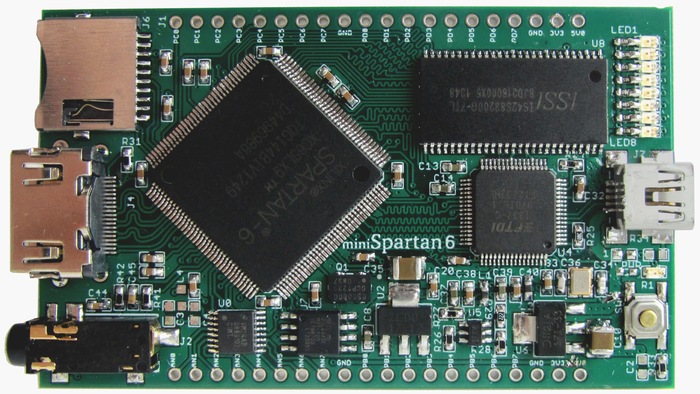
“miniSpartan6+: A Powerful FPGA Board and Easy to Use IDE.”
That’s the title of a successful Kickstarter campaign. No, really.
It’s for an analog-to-digital converter circuit: in English, a board for “computers that can take dozens of signals from the world and figure out what to do with them,” explained Umar Farooq, the cofounder of Scarab Hardware.
The Columbia, Md.-based startup has raised more than ten times its $7,500 goal and sold nearly 1,000 of the boards so far, thanks to the web grapevine.
That’s because Farooq, a Maryland engineer and Turkey-based freelance journalist, is participating in a rapidly expanding DIY hardware movement.
“Everything we do is open source,” he said. “We don’t really care about keeping the circuit design to ourselves.”
Spurred by the easy sharing of technical information and the declining costs of manufacturing, indie hardware is making its way into to the hands of tinkerers.
FPGA boards and other semi-experimental hardware, said Farooq, “used to only be used by engineers.” Now, they’re available to anyone who wants to make a toy or more.
In fact, Farooq said over half of the miniSpartan6+ boards he’s sold are being shipped to buyers abroad, including in places like Eastern Europe, the Middle East and East Asia
To make the board, Farooq and his colleague combined their engineering background with advice picked up from other DIY hardware enthusiasts to figure out “what works and what doesn’t work in the product.”
Then, they drew the circuit board on the EAGLE (Easily Applicable Graphical Layout Editor) software and, presto, sent the design to RushPCB, a printed circuit board maker in San Jose, and to Carson, Calif.-based Acme PCB Assembly, where the circuits are installed on the boards by a pick-and-place machine.