Startup profile: Pression
- Founded by: Adam Salamon
- Year founded: 2019
- Headquarters: Coatesville, Pennsylvania
- Sector: Medical
- Funding and valuation: Undisclosed
- Key ecosystem partners: Nextfab Studios
There’s a therapy for certain heart patients that can require a 700-pound machine and a dedicated room. During treatment, balloon-like cuffs squeeze a patient’s calves, thighs and hips in rhythm with the heartbeat.
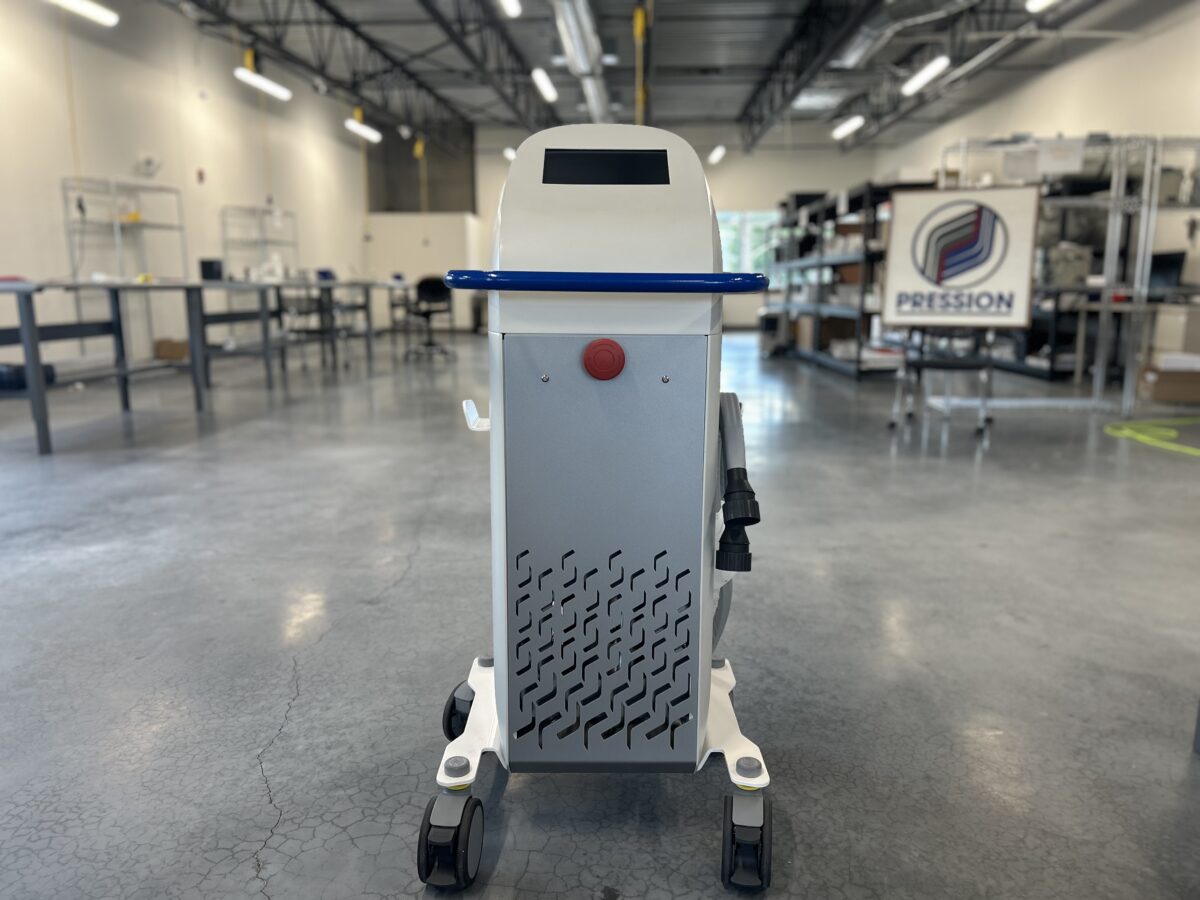
By contrast, Coatesville, PA-based Pression’s version rolls on wheels, stands about four feet tall and uses sleeves that wrap around the calves alone.
“It’s an automated therapy delivery that we designed to bring to places the previous therapies couldn’t go because they were too large, they were too expensive, they were too staff-intensive,” founder and CEO Adam Salamon, a former Lockheed Martin deputy corporate chief scientist, told Technical.ly. “Our system is designed to increase access.”
“We want to build it here … in Pennsylvania, as much as possible.”
Adam Salamon, Pression
Called Wave PRO, it shrinks the equipment enough that several units could be used in the same room, not unlike a kidney dialysis clinic.
The technology behind Wave PRO began as a project aimed at reducing fatigue during intense physical activity. The FDA cleared the device in December 2025, including for certain adults with recurring chest pain caused by reduced blood flow to the heart that doesn’t respond to medication and who aren’t candidates for procedures to restore blood flow to the heart.
Since then, Pression has begun scaling manufacturing as its sales team targets critical access hospitals, rural hospitals, cardiac care centers and skilled nursing facilities.
From military performance to heart care
The project’s first intended users were military personnel.
“This was intended to help our women and men in uniform who are forward deployed to be better prepared to do their job,” Salamon said.
Salamon formed Pression in January 2019. He initially bootstrapped the startup, with additional support from grants of roughly $10,000 to $20,000 from startup competitions.
An investment from NextFab Studios‘ hardware accelerator in 2019 allowed Pression to build its first prototype and begin testing with athletes.
Pression remained focused on physical performance and sports. The pandemic forced the startup to reconsider that market, and the company pivoted toward healthcare, eventually identifying external counterpulsation, or ECP, as an application for its compression technology.
That pivot meant turning the technology into a regulated medical device. Pression spent the next several years developing and testing Wave PRO before submitting it to the FDA in March 2025. The agency granted the go-ahead on Dec. 22.
The startup closed a Series A in 2025 but declined to disclose the amount.
“You roll it into the room. You put the sleeves on the patient’s calves. You put one sensor on their fingertip, and you press start,” Salamon said. “The system takes care of the rest.”
That fingertip sensor uses photoplethysmography, or PPG, to identify when the heart is in its relaxed phase between beats and time the compression.
COO Alain Van Loo said designing a smaller device presented challenges, as the team had to consider not only what fit inside the cart but its height, weight and balance.
The treatment course itself remains substantial. A typical full course of ECP is 35 one-hour sessions. Wave PRO doesn’t shorten that treatment, but Pression said its smaller, automated equipment can reduce some of the space and staffing demands that make traditional ECP difficult for providers.
Now to build and sell it
Since receiving clearance, Pression has expanded its Coatesville facility by another 3,000 square feet, more than doubling its footprint. The company plans to perform final assembly, testing and distribution of Wave PRO there.
It has also built a regional supply chain.
“We want to build it here, and not just here in the US, but here in Coatesville as much as possible, here in Pennsylvania, as much as possible,” Salamon said.
With few exceptions, components are made within roughly 90 minutes of Pression’s headquarters, Salamon said. Machining is done in Honey Brook, about 25 minutes away, while pneumatic components come from York.
Pression has four full-time employees and a broader team of about 20, including consultants and other collaborators.
Universities are also part of its workforce pipeline. Pression hosted four interns this summer from West Chester University and Swarthmore College and has previously worked with students from Penn, Drexel and Rochester Institute of Technology. All three of Salamon’s other full-time employees first came to Pression as students.
For now, the company’s most immediate measure of progress is finding customers for Wave PRO.
“We have our first unit in the field with our sales team,” Van Loo said, “and we’re looking to hopefully do first sales in the next couple of months.”