Startup profile: OralExam.AI
- Founded by: Darryl Glade, John Renne and Kevin Truong
- Year founded: 2026
- Headquarters: New Orleans, LA
- Sector: Edtech
- Funding and valuation: Self-financed
- Key ecosystem partners: Idea Village, Tulane University, Tulane Innovation Institute
A Louisiana startup is building a tool to help higher ed find its way in the AI age by combining the tech with a teaching approach thousands of years in the making.
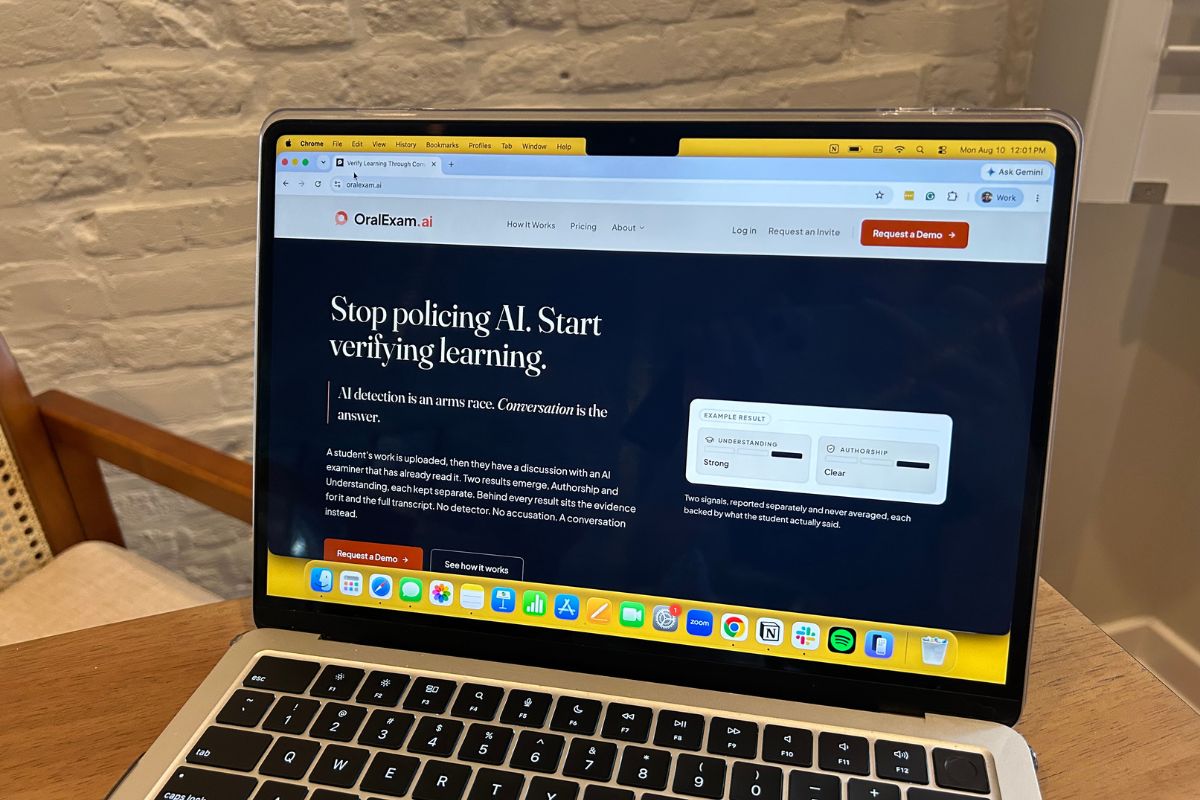
OralExam.AI is not built to grade papers or run detection scans. Instead, it uses agentic AI to conduct interactive conversations with students, assessing whether they truly understand the material they submitted.
Cofounder Darryl Glade, a professor at Tulane University in New Orleans, modeled the platform around the Socratic method, the practice originated in ancient Greece that uses open-ended discussions to prioritize critical thinking instead of handing down facts.
“We want to make sure that students are learning, and that their professors are no longer AI detectives.”
Darryl Glade, OralExam.AI
Rather than asking faculty and teachers to play detective and potentially accuse students of cheating, Glade hopes his tool will help bring focus back to actual learning.
“We are at a sea change moment in education because of artificial intelligence,” Glade told Technical.ly. “Since we can’t really detect [AI], how are we going to alter our assessments, and how are we going to make changes?”
AI detection has become a major headache for high schools and colleges. False positives put students and educators in a tricky position: students have to “prove” they didn’t use AI, which can erode trust when a teacher or professor doubts their work — sometimes even ending up in court over it.
While tech is improving, no system is perfect. AI-detection software Pangram, for example, attracted attention as a promising option in college admissions, but researchers and practitioners still caution against treating its scores as definitive evidence about an individual’s work.
That has pushed some colleges to rethink AI detection. Institutions are disabling AI-detection tools in software like Turnitin, sometimes considering software from similar startups like Baltimore’s Cursive Technology to monitor the writing process. Capturing keystrokes and other activity could offer evidence, but it also blurs the line between academic integrity and digital surveillance.
OralExam pitches itself as a different bet. Rather than determining whether writing was AI-generated or monitoring students as they write, it lets them do take-home work and then demonstrate what they know directly. The idea is to assess whether students understand the material, whether or not they used AI.
Using live conversation for analysis, instead of pre-written text
OralExam, which announced pilots launching this fall with a handful of high schools and universities (including Tulane), offers three ways for instructors to create an assignment:
- Upload an assessment so the AI agent generates targeted questions
- Provide overall course learning objectives to help the system target key concepts
- Upload nothing and let the platform rely on its own knowledge base to generate questions and evaluate responses
Then the student uploads their work into the assignment portal. OralExam uses it to generate targeted, specific questions — and conducts a live, spoken interview with the student. For example, it might ask why a student chose a particular quote from the text to support their argument, rather than asking them to list details about the quote like the exact phrasing.
It then rates the submission on a variety of axes, like “thesis understanding,” “evidence knowledge” and “authorship” potential. To make things more equitable, a recent update by the development team instructs the tool to pay attention only to the content of a student’s answer, not their public speaking ability or perceived vocal confidence, when making its assessment.
“It’s actually very important to us to make sure that this is usable by the broad section of students,” Glade said.
From there, it’s up to the professor to decide how to proceed. OralExam remains neutral on institutional AI policies. The focus is strictly on evaluating comprehension rather than catching rule violations, according to Glade.
Roughly 7 in 10 teachers feel comfortable using AI for lesson planning and grading, according to a January 2026 survey by Youngstown State University. About half say the tools are reducing burnout and saving time.
“This came from people who experience this on a day-to-day basis,” Glade said. “We want to make sure that students are learning, and that their professors are no longer AI detectives and they can grade with confidence.”
The startup is also working on ways to scale, building APIs and connections with various classroom management programs like Canvas and Blackboard.
“The larger aspiration,” Glade said, “is to immediately give institutions the confidence they need that they’re able to continue the overall objective of teaching students.”