• Half of Americans now gather information from AI tools weekly, and editorial media drives 46% of AI responses. The places that invest in independent storytelling are shaping what AI systems say about them.
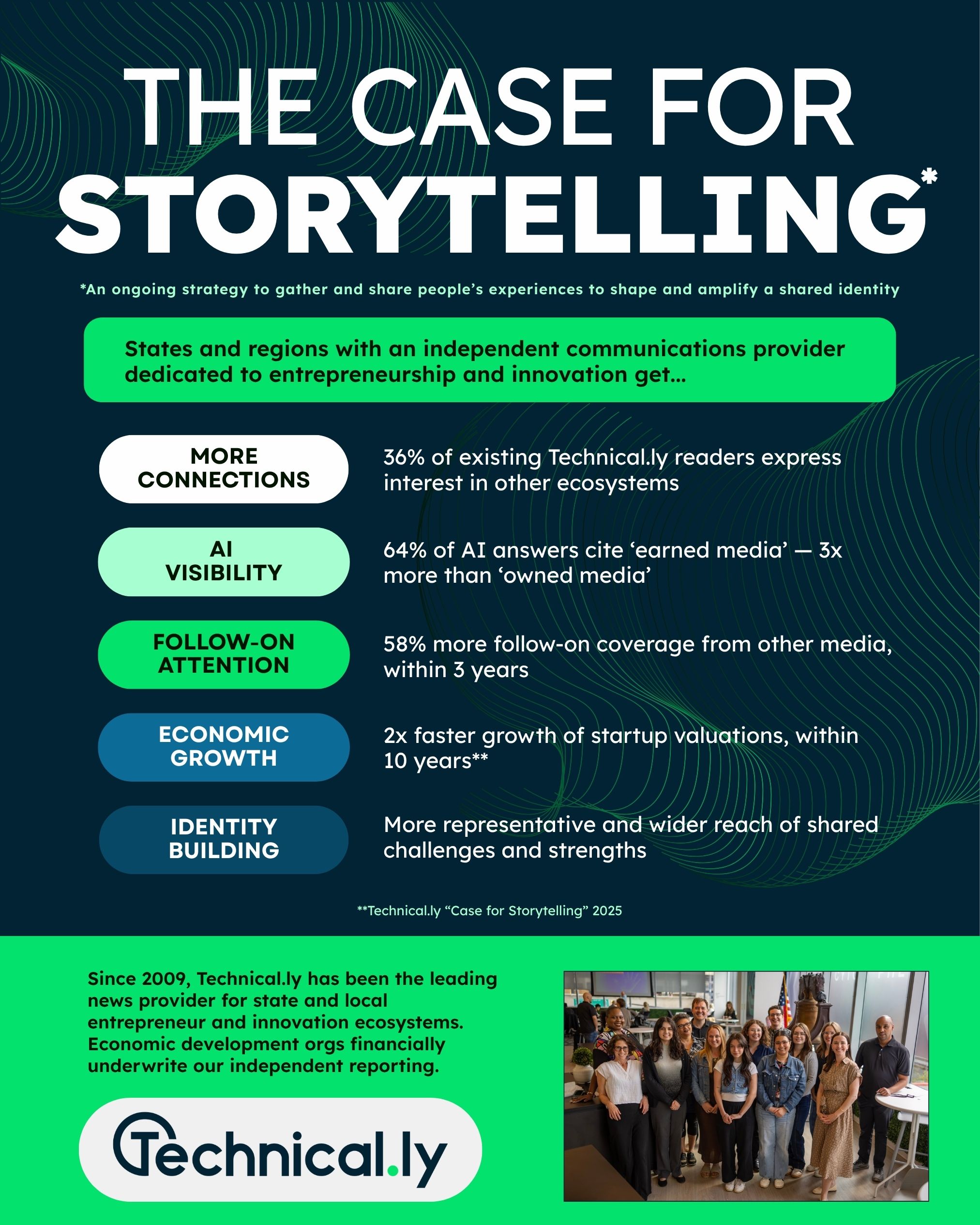
• Regions with dedicated entrepreneurship and economic storytelling received 58% more follow-on coverage and doubled in startup-valuation size compared to peer regions without these resources.
• Ecosystem storytelling is less marketing and more infrastructure. It lowers search costs, improves signaling, helps people find one another, creates reusable data, and makes coordination easier. But it’s underprovided unless funded as a shared asset.
Sean Luther isn’t one for exaggeration. So I listened when he described a small experiment he ran.
The head of InnovatePGH, Pittsburgh’s high growth–minded economic development nonprofit, wanted to understand how place-based narratives are changing. He dug into the sources and citations that AI tools use when asked to summarize Pittsburgh’s standing in technology, entrepreneurship and the sciences.
Among the most consistent sources he found? Technical.ly.
This fast-growing behavior — half of Americans now gather information from AI tools weekly, and two-thirds of young people — forces economic development and place-based marketing to think critically: What will shape this new disintermediated information provider for entrepreneurs and skilled professionals around the world?
Who gets included or doesn’t, who shapes it and leads it — all of that work today shapes our economy tomorrow.
We at Technical.ly have planned for this new stage of storytelling. But by no means do we think AI tools are the only driver. As evidenced by the storytelling focus of our annual Builders Conference, which we held this month in Philadelphia for the US Semiquincentennial, we think of communications and narrative development as a primary battleground for our communities.
Entrepreneurship and innovation is where an economy begins. Who gets included or doesn’t, who shapes it and leads it — all of that work today shapes our economy tomorrow. After two days with 350 ecosystem leaders and entrepreneurs from 35+ US states and several countries, my head is swimming with what we now know about storytelling strategy for state and local economic development.
Storytelling is economic infrastructure, not a marketing expense
I have a favorite definition: Storytelling is a process that uses character and plot to share ways to navigate a complex world. Most of us simply connect better to a person’s experience than even the most compelling data point.
Technical.ly’s journalistic approach to storytelling means we gather people’s experiences and match them to data, trends and research to present a truer version of the world. This, it turns out, is an especially effective way to develop a shared understanding among locals, which research shows is the foundation needed to speak authentically to the outside world.
Done well, a storytelling strategy requires three big stages: gathering, distributing and listening. That work is done best for ecosystems with an ecosystem approach.
At our conference, economic development leaders from Maryland to Louisiana, North Dakota to North Carolina and New Mexico to Maine reinforced that any shared resource creates efficiencies for many others in a community. Bridges and trains are one kind. So is a shared narrative of a place, with an open platform — something independent like Technical.ly, rather than one owned by a single economic development organization.
“Storytelling is a critical tool for organizing,” said Fay Horwitt, the longtime entrepreneurship organizer who helped launch the ESHIP Alliance, a national gathering of her peers.
As Technical.ly has argued before, coordinating across organizations, grassroots efforts and new emerging firms has to extend past gaps in visibility to achieve coherence and then legitimacy. To be most effective, a communications platform needs to be accessible, which means someone needs to pay for this public good to generate knowledge and transparency spillovers.
Of the 100 largest regions in the country, fewer than 1 in 4 have something resembling a dedicated innovation communications or storytelling provider. Several come from legacy media, more are now operated by traditional economic development. We at Technica.ly are an outlier, peers with a few single-market efforts but no one investing in storytelling both locally and outside a home market.
As said by Hollie Mackey, who leads North Dakota’s National Science Foundation-backed agtech research coalition, most everyone in the sciences and technology knows that communicating their work is important. But for something as familiar as storytelling, it’s easy to overlook. Across US states, there is wide divergence in storytelling effectiveness.
Storytelling is like exercising: No matter how expertly you plan a single workout, it won’t do much for your body. It’s an ongoing process, an infinite game. Silicon Valley and Boston need storytelling just as much as Mississippi and Wyoming, if for different reasons.
When most states and regions have entrepreneurship and innovation investments, the difference will be if anyone knows it. More places and institutions are investing in that messaging, as the urgency grows, said University of Maryland’s system-wide research chancellor Michele Masucci, who hosted a science communication symposium in March.
When the main function of storytelling is to make a field legible, searchable, trustworthy and actionable for many users at once, it behaves less like a campaign and more like a shared information layer. It lowers search costs, improves signaling, helps actors find one another, creates reusable data and makes coordination across an ecosystem easier.
Because those benefits spill well beyond any single firm or funder (everybody benefits a little bit), said Arlington, Virginia’s Tally Wolff, the market tends to underprovide it—unless it’s funded and governed as a shared asset.
That’s why Technical.ly’s business model works: we function as visibility infrastructure for the regions we cover. Not content production. Visibility infrastructure.
The empirical case is now measurable
At last year’s Builders Conference, we shared the first results from a multi-year research project on what happens when regions invest in dedicated ecosystem storytelling.
The findings:
- Regions with dedicated ecosystem news organizations received 58% more follow-on media coverage within five to seven years compared to peer regions without storytelling resources
- Ecosystems investing in dedicated storytelling approximately doubled in size compared to peer regions over a 10-year period, according to Startup Genome valuation data
- These operations, running on relatively modest budgets, generated an estimated 5-10x return on annual value creation. A typical investment is $150k-$250k annually, with gains exceeding $500k-$1.5M in follow-on coverage alone, setting aside connections and growth.
Other research tells the same story in different languages. In a 2023 analysis of broadband adoption’s effects on labor markets, researchers found that recruiting with a news and information resource led to shorter job vacancies and fewer unsuccessful hires. A storytelling and information strategy reduced unemployment by 14% by matching people to resources.
The local news research shows similar dynamics. A 2020 analysis found that local newspaper closures increase municipal borrowing costs by 5 to 11 basis points, at about $650,000 per bond issue. Related research finds closures also increase bank loan spreads for nearby firms.
Viewed through an infrastructure lens, independent storytelling does identity building, matching and monitoring work for a locality’s economy. Each individual organization markets its own priorities, but a dedicated storytelling provider is what stitches together a shared narrative.
As Nexus Louisiana’s NaTisha Natt said: “A story helps us build together.”
When it disappears, the costs show up in startup growth, economic accessibility and opportunity.
The AI visibility shift is real
Gathering stories is itself an overlooked step by economic developers. Distributing what stories a place has requires its own strategy. News organizations are rightly focused on engaging an audience — for us at Technical.ly that’s site visitors, Slack members and newsletter subscribers, in addition to extended reach via social media through initiatives like our creator-in-residence program.
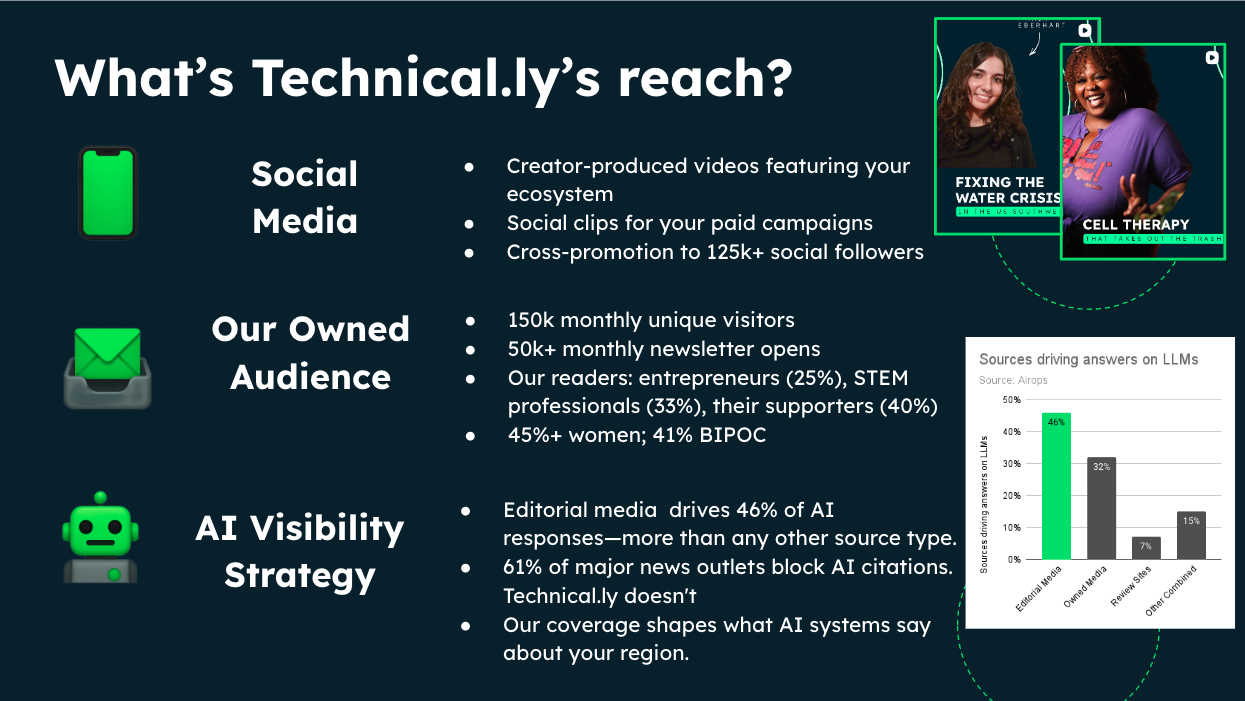
About distribution’s new, third component: 61% of major US news outlets, including the New York Times, Wall Street Journal, CNN and Bloomberg, now block AI chatbots from citing their content. Technical.ly doesn’t.
Editorial media drives two-thirds of AI responses, more than any other source type, according to Airops research. That means coverage in blocked prestige outlets generates awareness but won’t influence what AI tells people about a region. Technical.ly coverage brings both: credibility and AI citability.
We’ve leaned into this deliberately. Our editorial team optimizes stories with summaries, FAQs, subsections and structured data that AI models more readily surface in responses. Our newsletter conversion rates from AI referrals are 2x higher than search traffic and 1.5x higher than direct traffic.
That’s no gimmick: We saw Technical.ly coverage correct a decade-old error about one company in AI results within hours of publishing.
That’s why another organizer in Louisiana, where Technical.ly recently expanded, told us: “Without the story being written and shared, it’s as if our entrepreneurs, our innovators, the programs and resources, are invisible, both at home and to the rest of the country.”
What we demonstrated at the Builders Conference
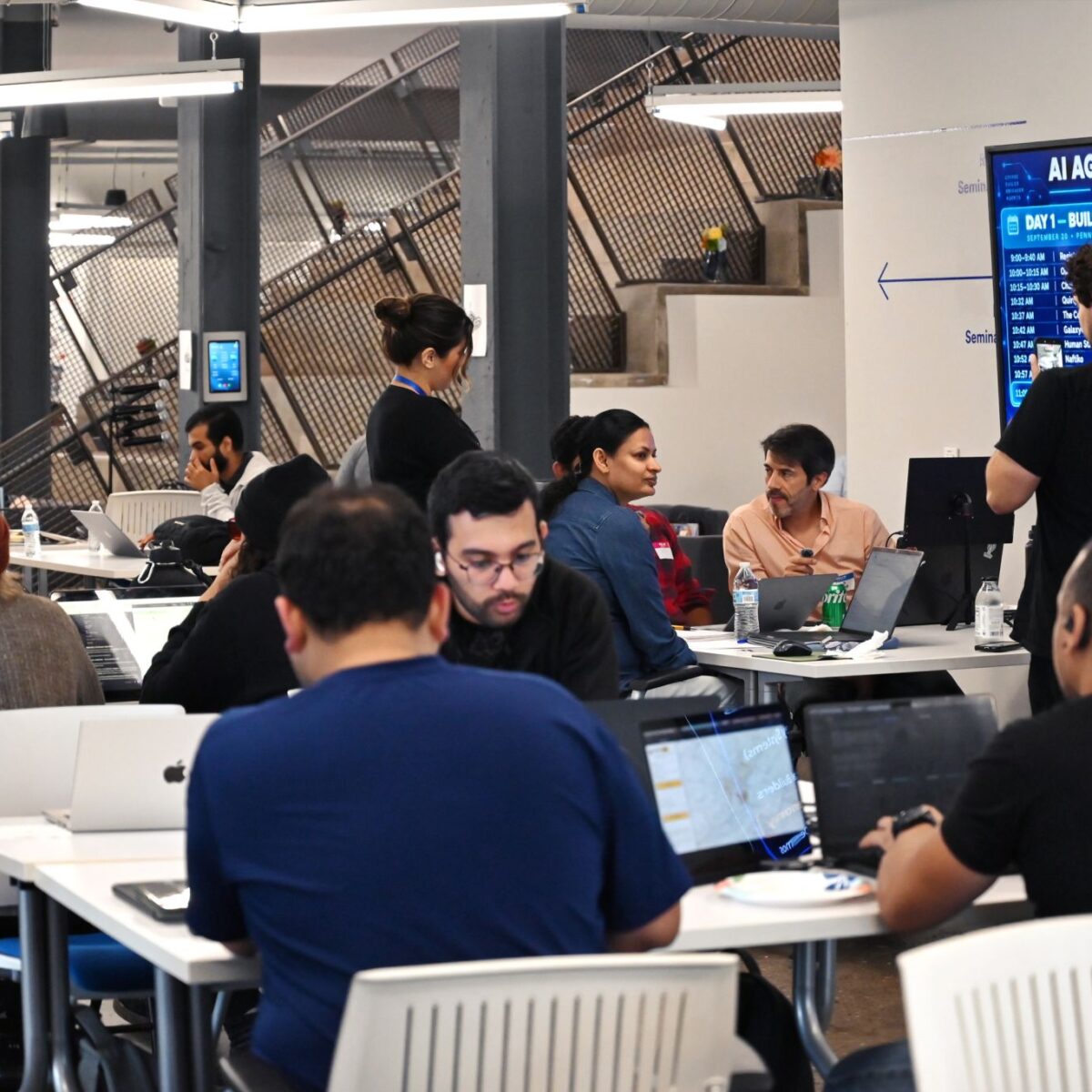
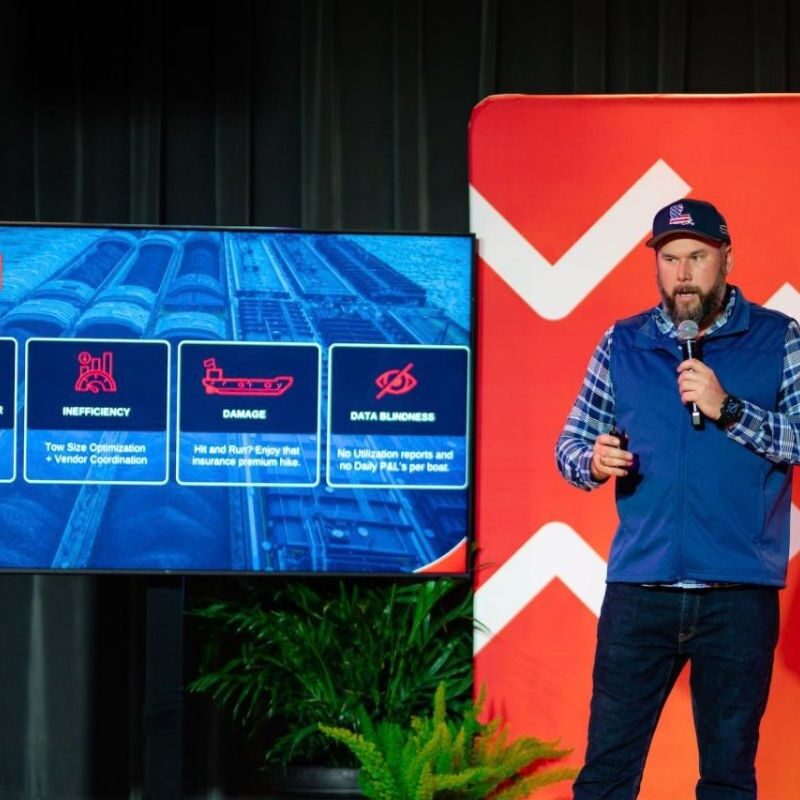
Our conference itself is a proof of concept. We put on-site storytelling to work in more than a dozen forms across two days. This is what we do for economic development leaders across the country. Examples:
- Our newsroom recapped key takeaways from all the conference sessions, publishing them within hours and also creating a future reference archive
- A three-year reporting project gathering feedback from 1,000+ residents culminated in a vision statement for Philadelphia 250 years in the future, and then attendees painted portions of a mural inspired by that vision, led by artist Sean Martorana
- Middle-schoolers developed games to play on the side of a Philadelphia skyscraper, led by Drexel’s Frank Lee and supported by Brandywine Realty Trust
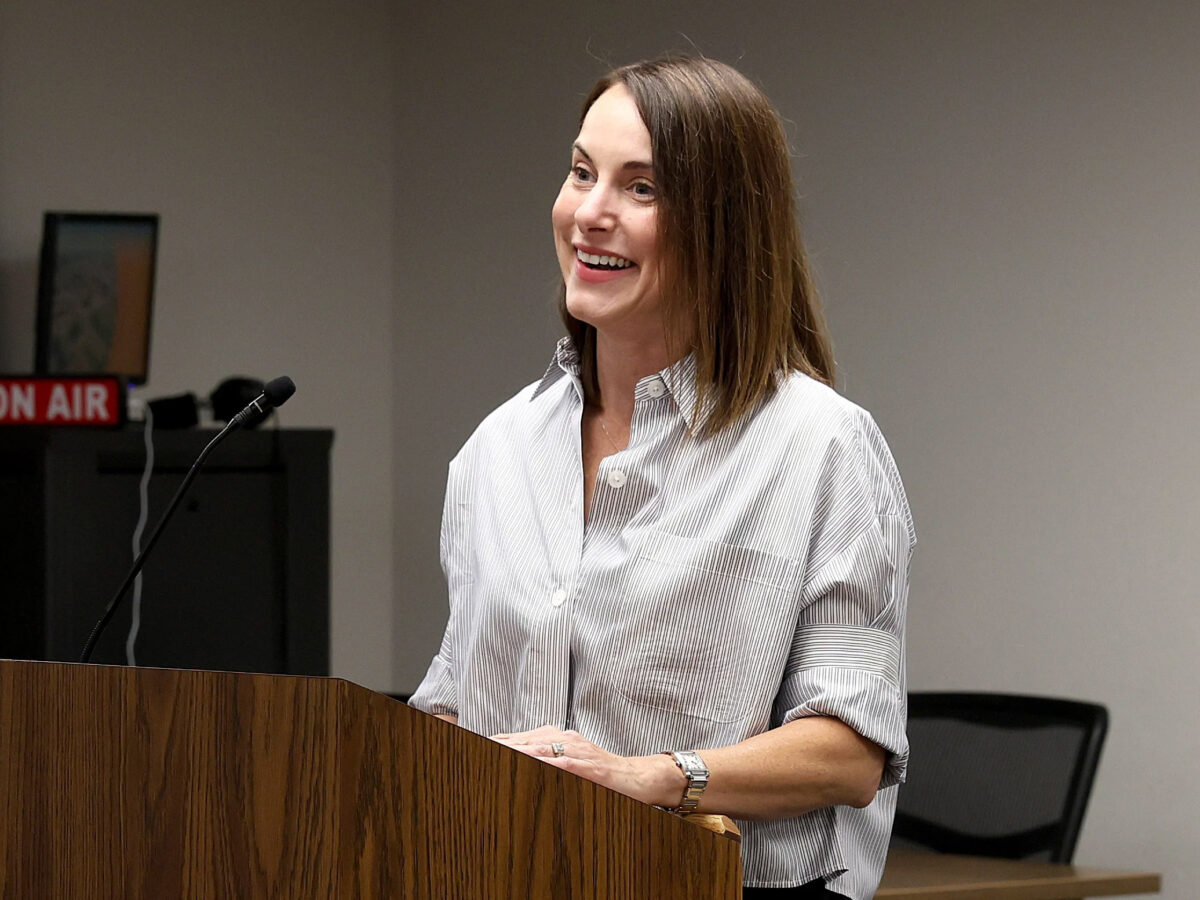
- A dedicated podcast booth staffed by our team allowed attendees to record intimate conversations, including by North Dakota’s Hollie Mackey (NSF AgTech Engine), South Carolina’s Aaron Taylor (Ecosystem Scale) and Virginia’s Anika Horn (Ecosystems for Change)
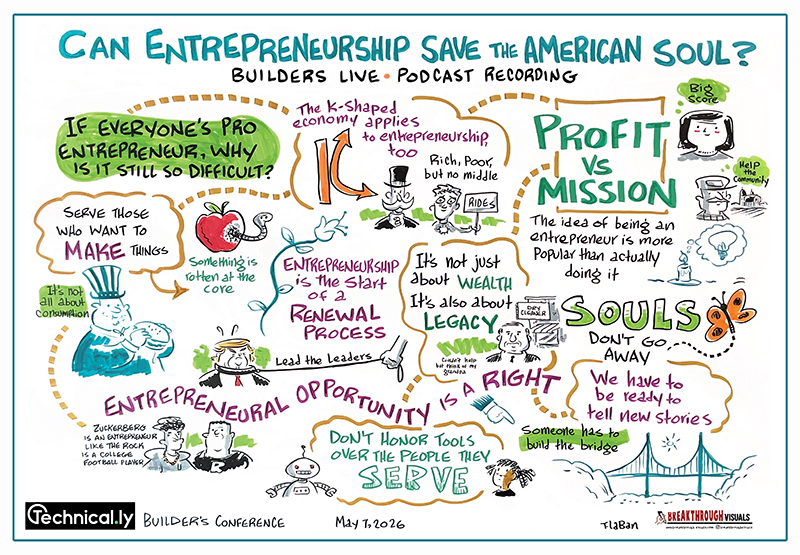
- Graphic illustrator Terry LaBan (Breakthrough Visuals) illustrated summaries of discussions, giving us lasting, shareable artifacts
- A Creator Lab led by editorial director Danya Henninger produced short-form video takeaways, as we lead with social-led reach
We also held sessions in three content tracks:
- Storytelling case studies, which featured practitioners from across the country, everywhere from Maine (Aaron Weiskittel) to Montana (Tim VanReken), Louisiana (Na’Tisha Natt) to Ohio (Brian Brackeen), Alabama (Rae’Mah Henderson) to Indiana (Morgan Allen)
- Applied AI sessions led by real practitioners (not futurists) including Jason Michael Perry, Sean Blanda, Dawn Gibson Wages, Luis Cielak and Tariq Hook, all informed by our published AI ethics framework
- Interactive fishbowls where ecosystem builders worked through real problems with entrepreneurs
Across all, the point was that economic development, technology, science and entrepreneurship needs to message the importance and accessibility of this work. Put most ambitiously, it’s an effort to save the American soul.
If you run an economic development organization, a tech council, a university innovation arm or a regional partnership, here’s the practical takeaway:
The question is not whether to invest in storytelling. The question is whether you’re building an asset that compounds — or paying for one-off campaigns that evaporate.
A shared storytelling layer becomes economically useful when it is:
- Persistent: Not campaign-driven, but ongoing and cumulative
- Queryable: Searchable, structured, machine-readable (not buried behind a paywall)
- Trusted: Independent enough that people believe it
- Connected to workflows: Linked to hiring, investment, procurement and policy, not ornamental
The “independence” piece of independent storytelling is economically relevant, not just ethically preferable. Reuters Institute research shows that audiences generally view news encountered on digital platforms more skeptically than news media overall. Credibility scholarship emphasizes trustworthiness and expertise as key dimensions of source credibility.


That doesn’t mean all independent storytelling is trustworthy or all marketing is untrustworthy. It means that editorial distance, transparency and recognizable standards are economically useful design features, not moral decoration.
Last year, Tammi Thomas, recently promoted to lead Maryland’s state-backed investment and economic development firm TEDCO, put it this way: “Technical.ly helps us make the case for investments in entrepreneurship, technology and the sciences, with the people stories and data-backing together.”
The test of success should be: Does the system make the ecosystem more readable to itself and more actionable to outsiders, in ways that change coordination and outcomes?
If yes, then impressions and engagement are merely intermediate signals, not the main event.
The organizations and regions that grasp this can perform a bit closer to their potential. The ones that don’t will keep paying for campaigns while wondering why their ecosystems remain invisible to themselves — and to the AI systems that increasingly shape how the world discovers opportunity.
Storytelling comes in many forms. We demonstrated that at the Builders Conference. But the through-line is simple: The new battleground for economic development is information. The places that invest in making themselves legible, to people and to machines, will be the places that get found.