
New US military trauma training standards are pushing simulator companies to rethink design — and an Aberdeen firm says affordability is now part of the specs.
Lifelike medical training mannequins help US military personnel practice trauma care, but they can come at a premium. The most advanced models — with responsive bleeding and breathing features that mimic complex medical conditions — cost up to $200,000.
“You can practice it all on a simulator to get over all of those taboos, so once you’re confronted with the real thing, you’ve already trained past it.”
Martin Currie, Operative Experience
Operative Experience (OEI) recently released the Tier 3 Pro, a model that cuts costs by getting down to the basics, according to marketing director Martin Currie.
“We really tried to find the sweet spot of what they were looking for, features-wise and the level of realism,” Currie told Technical.ly, “but also at the right price point.”
OEI declined to publicly share pricing details or a cost comparison to other simulators, making it unclear how much cheaper the new model actually is. The new product meets Tier 3 standards under the Tactical Combat Casualty Care (TCCC) framework, a four-level military training program introduced in 2022, meaning it’s designed for combat medics and corpsmen.
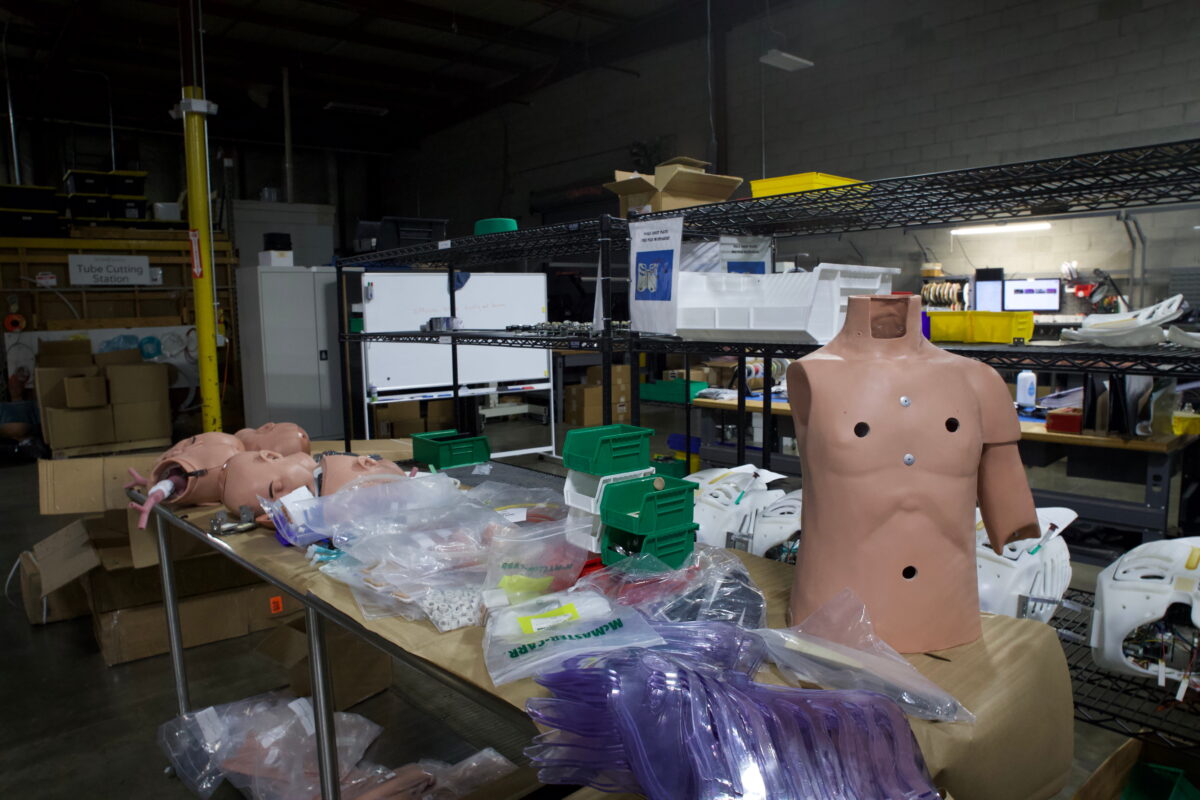
OEI’s trauma care simulators mimic wounds like collapsed lungs after explosions and open fractures on a plastic mannequin.
The company lowered the cost of its product by tailoring the design to core military training needs, like checking airways and practicing tourniquets, per Currie. It doesn’t include the modular features of some of OEI’s other mannequins, which let trainers swap limbs to simulate different injuries.

The product contains a blood reservoir controlled via iPad, allowing instructors to trigger bleeding from multiple wounds. That bleeding stops only when a procedure is performed correctly, giving trainees hands-on experience controlling blood loss.
The software also regulates breathing, heart rate and circulation.
“You can practice it all on a simulator to get over all of those taboos, so once you’re confronted with the real thing, you’ve already trained past it,” Currie said.

Training for trauma beyond just male bodies
Tier 3 Pro isn’t the first time OEI has launched a specialized product to address a military training need.
In 2018, the company received a $3.6 million Small Business Innovation Research (SBIR) grant from the US Army to develop an advanced female trauma simulator.
Military studies show that battle-injured women face higher fatality rates than men. However, in civilian environments, men are at a greater risk of death from injuries.
While the exact causes remain uncertain, some researchers suggest part of the gap stems from training. When service members train only on male-bodied simulators, they don’t get the chance to practice techniques specific to treating women. For example, people with female physiology typically have smaller sternums, which can affect how injections are practiced.

The simulator also helps service members overcome the psychological barrier of examining a female patient for injuries, which can involve undressing to check for wounds. Men are often hesitant to remove a woman’s bra, leading to missed injuries, according to Currie.
OEI’s female-bodied simulator became the first accredited by the Army in 2024 and has since been deployed to all US Army Medical Simulation Training Centers.
“Women’s anatomy is a lot different,” Currie said. “If you’re practicing everything on a man, it’s just not as accurate for the field.”