
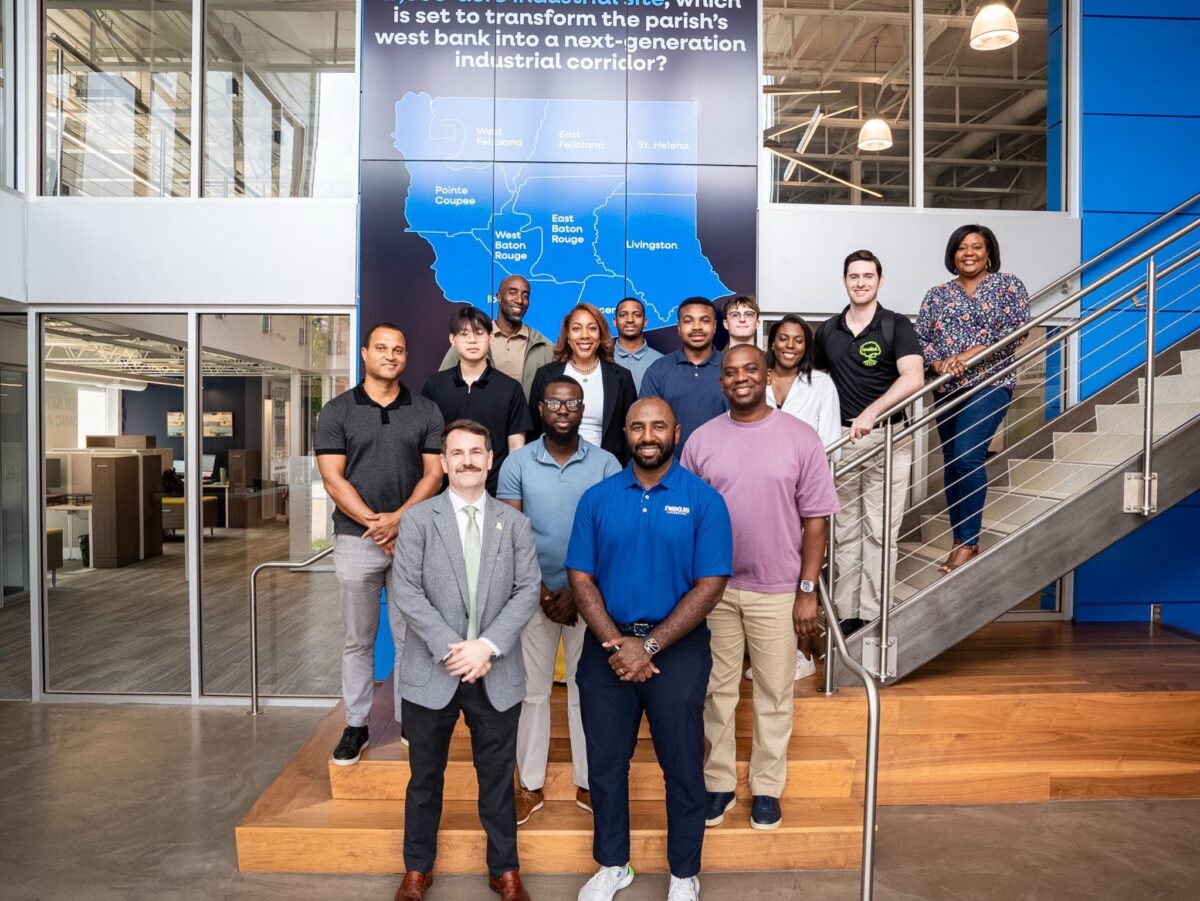
Tony Zanders doesn’t use the word “entrepreneur” anymore.
Last year he was hired as the CEO of Nexus Louisiana, the nonprofit charged with building the Bayou State’s startup ecosystem. He removed the popular term from his organization’s website within months of taking the role.
“That is such a broad term that encompasses anyone who is working on their own business,” said Zanders, who previously founded talent platform startup Skilltype. Going back decades, most US states have a portfolio of small business strategies — and sensibly so, as hordes of local wealth sit in them. So Zanders has focused on what he sees as the biggest omission: high-growth, venture-backable startups.
He has a test for audiences. Ask how many would be thrilled to make $1 million in revenue this year. Some raise their hands. Then ask how many would be “grossly disappointed” if they only made a million. A different group raises their hands.
“That’s how I explain the difference between an entrepreneur that’s a small business owner versus a high-growth tech startup,” he said.
Nexus Louisiana made its choice. The organization’s 10-year goal: 1,000 net-new startups that are building technology, are candidates for venture capital or federal grants like NSF funding, and are capable of hiring and scaling. Research defends his focus: the “multiplier effects” of new firms that commercialize science and technology start the economic flywheel. Entrepreneurship is where an economy begins.
Nationwide, there’s debate on what the balance should be. The United States is experiencing record business formation, but the growth is K-shaped. As entrepreneur support strategies matured over recent decades, there’s been an increase in innovation-led startups, typically estimated at 1 of 100 new firms. But the overall share of new businesses that ever hire someone collapsed, as nonemployer firms grew. The middle hollowed out.
So when a state economic development strategy talks about “entrepreneurship,” the question is: Which kind?
“If you want to open up a landscaping company, we can point you to our colleagues at the SBDC,” Zanders said. “But if you want to reinvent the lawnmower and create a solar-powered lawnmower that uses 50% of the energy, you got to come to Nexus.”
The theory of change inverts the typical accelerator pitch. Nexus isn’t trying to coach self-styled entrepreneurs into building in a specific industry. It’s trying to turn industry experts into founders.
“I can’t teach you that subject matter expertise, but I can teach you how to build a startup,” Zanders said. “Our bias is towards people who have deep expertise in a particular problem area… Our job is to convert you into an entrepreneur.”
Louisiana needs this to work as a statewide strategy because it has no other choice.
Translating industrial strength into long-term tech upside
The state has 4 million people. That’s fewer than the Houston metro alone.
“We don’t have the luxury of New Orleans competing with Baton Rouge, or Lafayette competing with Shreveport,” Zanders said. “That’s a luxury Texas has, where Houston and Dallas and Austin can have these really large, self-sufficient ecosystems unto themselves. We have to think as a state.”
This is a harder case to make than it sounds. Louisiana ranks among the bottom of states for population growth. It’s losing residents while the broader Sun Belt booms around it.
A 2024 report from the Nasdaq Entrepreneurial Center ranked New Orleans No. 14 nationally among startup ecosystems with potential. But it flagged significant headwinds: less than $400 million in recent annual venture capital funding, the ongoing population decline since Katrina and a lean social safety net that raises barriers to entrepreneurial risk-taking.
Zanders’ bet is that Louisiana does have available capital, but too few founders with the ambition and the vision to command it.
There are bright spots. The state ranks in the top five in the US for natural gas production and top 15 for overall energy output, infrastructure that matters for the emerging carbon-management economy. The Trump administration has continued Biden-era federal industrial policy, which in Louisiana includes a National Science Foundation-backed research and commercialization coalition focused on energy innovation.
Meta’s Hyperion data center in Richland Parish in the North Louisiana Delta Country, which Zanders cited, represents a projected $30 billion economic impact. It’s the kind of economic development splash states dream of. Zanders reframes it as a startup success story.
“You can’t have $30 billion in economic, tax-incentivized impact without 20 years ago this very small seedling of a company starting,” he said, pointing to Facebook’s origins in a Cambridge dorm room. “That new line is what we communicate when we’re talking to policymakers. If you want that without having to lure them with tax incentives — if you want to create that homegrown — this is the work.”
His 1,000-startup goal is meant to be measured in decades, not quarters. Last month, Zanders announced the start of his “Stealthmode Startup School,” which aims to gather founders with ambition and expertise and match them with opportunities.
“Silicon Valley took about a generation — 40, 50 years — to become what we know now,” Zanders said. “It was the Louisiana Purchase, not any other state, that we all learn about in school. I think it’s in our DNA to reassume a position of global import. And I believe technology will be the way that happens in this next generation.”