
It’s tough to avoid a little FOMO when your alma mater rolls out a shiny new program.
For many older founders, that feeling is familiar. Teaching entrepreneurship is a relatively recent phenomenon in higher education. US colleges offered about 250 entrepreneurship courses in 1985. By 2008, that number had grown to more than 5,000.
“We were really intentional about making it, rather than a sort of set curriculum, a choose-your-own-adventure.”
Jake Dreier, Pava Center for Entrepreneurship
At Johns Hopkins University, administrators realized many alumni missed the school’s entrepreneurship renaissance. This spring, the Pava Center for Entrepreneurship launched its first alumni accelerator, giving graduates a chance to reap the benefits they never had as students.
“There’s a whole generation of folks that predate entrepreneurship centers,” Pava Center director Josh Ambrose told Technical.ly. “We’ve been haunted by this idea of, well, what would it look like for us to give some of these supports to our alums?”
The inaugural alumni accelerator ran for 18 weeks. The program paired founders with advisors and hosted workshops. Like Johns Hopkins’ other advanced accelerators, each team also received a $5,000 nondilutive grant.
An anonymous philanthropist funded the program, according to Ambrose. The Pava Center hopes to continue offering the accelerator each spring, though its long-term future has yet to be determined.
About 60 alumni teams applied, with just nine making the cut. The cohort included startups spanning life sciences, defense and edtech. While participants received some shared programming, Pava Center leadership also tailored mentorship to each company’s needs.
“We were really intentional about making it, rather than a sort of set curriculum, a choose-your-own-adventure,” Pava Center assistant director Jake Dreier said, “of different tools, resources and mentors that each team needed to progress and move their venture forward.”
Alumni put down local roots
Johns Hopkins Alumni Accelerator Participants
- Athletes Intell: Helps college athletic departments support student-athletes’ mental performance and wellbeing through a digital platform.
- BRAIV: Uses AI to help psychiatrists identify the most effective treatments for patients.
- Brāv Vantage: Develops software that helps emergency response agencies track workforce readiness and coordinate deployments.
- Gargoyle Systems: Creates a decentralized network for detecting and tracking drones.
- Iksa.ai: Develops AI assistants for clinics focused on longevity medicine.
- LUMIQO: Streamlines clinical trial management with digital research tools.
- SmartSTAT: Automates inventory tracking for hospital emergency code carts.
- Teaching Tools: Builds software for colleges to improve and assess classroom instruction.
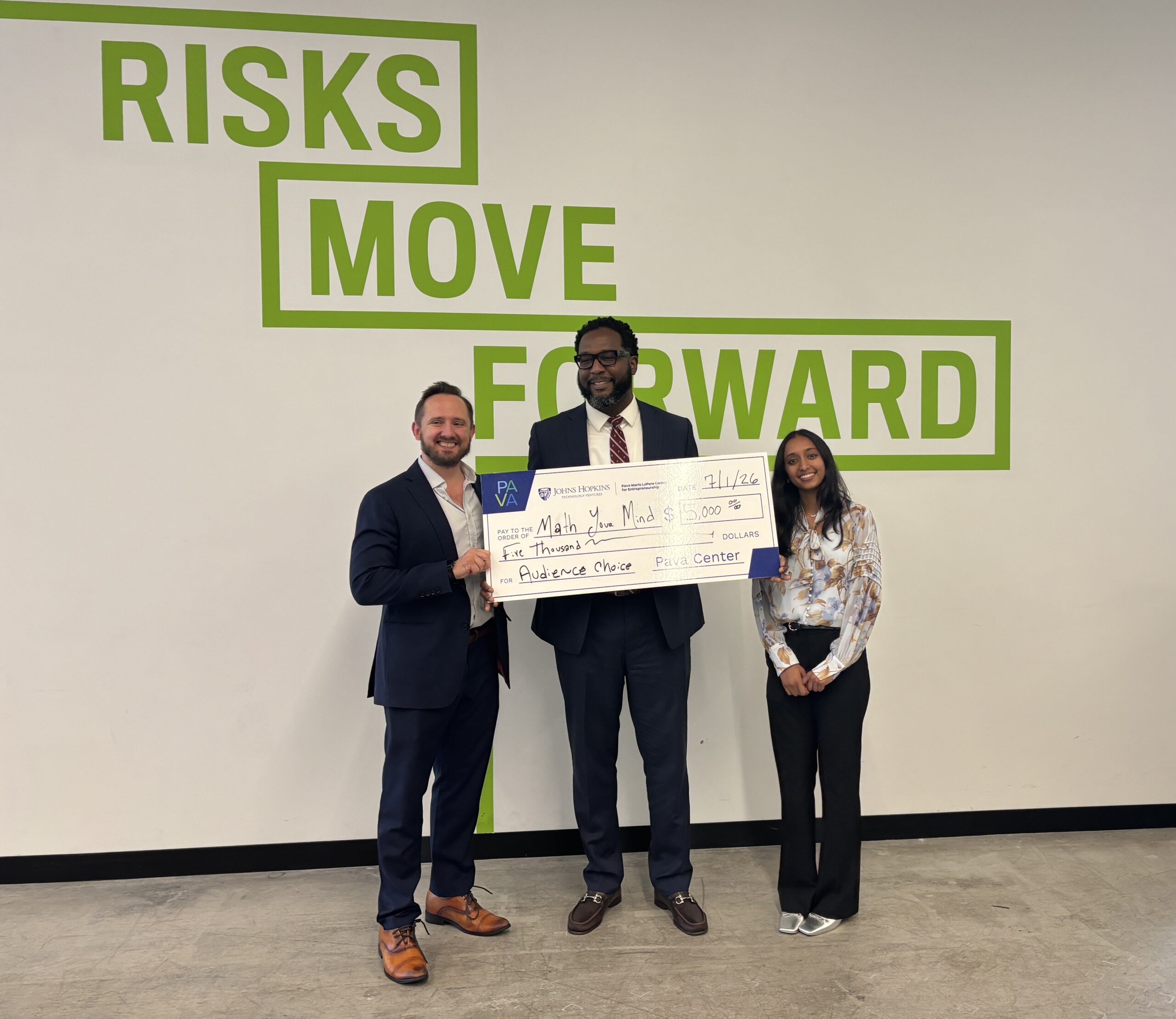
- Math Your Mind: Creates K–12 math education with interactive lessons and mentoring.
JHU’s investment in alumni paid dividends for Baltimore.
Three teams decided to relocate their startups to the city after joining the accelerator, Ambrose said. A fourth followed suit after seeing the progress made over the course of the program.
To attract alumni from across the country, the accelerator also offered remote programming for founders based outside Baltimore.
Gargoyle Systems took home the judges’ $15,000 grand prize at the accelerator’s final showcase. Cofounded by Hopkins alumnus Matteo Pietrobelli and Mike Fraietta, the company develops drone detection technology.
Originally launched in New York City, Gargoyle is opening a Baltimore office to be closer to potential federal customers.
“Being closer to here just makes sense,” Fraietta said. “Also, the talent — there’s a lot of talent here, and it just strategically works for us.”
Supporting alumni is also especially important, Ambrose said, because many founders don’t launch companies until they’ve spent years building their careers.
That’s true for the duo behind Iksa.ai. After nearly a decade working in healthcare, Shaurya Verma and Anand Ahuja reunited to launch a startup serving the growing longevity clinic market.
The pair met as undergraduates at Hopkins and quickly became friends. They graduated just before the university’s entrepreneurship ecosystem took off, fueled largely by the late Pava LaPere’s efforts.
“It’s really great to see,” Verma said, “how the ecosystem has evolved over those years when I wasn’t in the city.”