Adding AI to a tech product doesn’t immediately help users solve a problem.
Sometimes, it can even have the opposite effect, adding unnecessary hurdles to the user experience.
“A useful product gets out of the user’s way.”
Elizabeth Garrison, Shaping Development
Instead, consultants are saying to start by figuring out what customers actually need, rather than looking for ways to retroactively work AI into their products.
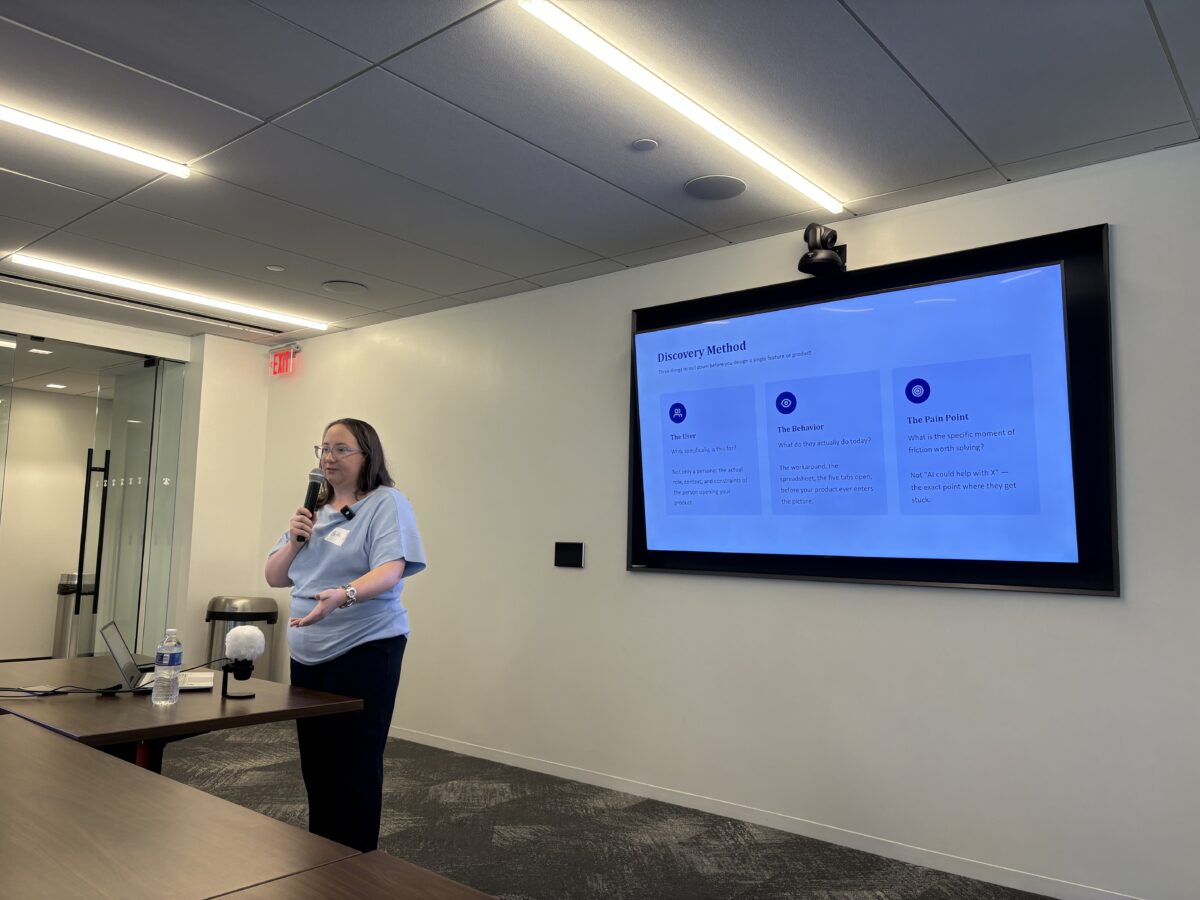
Building around the user, rather than the technology, can help startups avoid unnecessary features and create products people will actually use, Elizabeth Garrison, founder of AI and human behavior consultancy Shaping Development, said at Philly Builds AI’s Founder Series event, hosted at Ben Franklin Technology Partners’ office last week.
“AI startups actually winning aren’t the ones with the flashiest tech,” Garrison said. “It’s the people who deeply understand who they’re building for and why that person is stuck with the problem that they’re trying to solve.”
It’s an approach that many founders don’t consider.
Startup teams think they have to incorporate AI somewhere into their product because that’s what investors are looking for, Garrison said. There’s evidence behind that, as 86% of venture capital funding in the United States during the first half of this year went to AI companies, according to PitchBook’s Q2 Venture Monitor report.
However, there’s also a lot of distrust in AI tools now, so developers need to understand that skepticism, build around it and prove that their technology is actually useful to users, per Garrison.
“What wins now is really looking at the user fit, and the problem that it’s trying to solve, and the trust that the user actually has in your product,” she said.
For founders deciding whether AI belongs in their product, here are three things that Garrison recommends keeping in mind.
Watch how people actually work
Before designing a feature or product, entrepreneurs need to identify who the user is, learn what their routine is, and what difficulties they run into.
“[Not] thinking about … AI could help with this, but what is the exact point where they get stuck with a specific thing,” she said.
To start, observe people in their natural environment and use that information to come up with a proposed fix.
Then, founders should talk to users to better understand their experience, according to Garrison. This includes interviewing people who are skeptical of the tech, not just people who believe in the product. Make sure to include open-ended questions to get users thinking about their processes, she added.
Don’t build for the demo
Once founders make a product, they also need to avoid adding features just to make the demo seem cool, Garrison said.
Sometimes companies create new features just because they can, but an unhelpful tool requires people to add steps to their routine. Sometimes, they don’t even want to use AI, she said.
“A useful product gets out of the user’s way,” Garrison said. “It’s something that they would actually use in their day-to-day without learning something completely new.”
A good feature fits inside existing workflows and customers use it without thinking too hard about the fact that it’s there, she said. It also directly confronts the challenge developers previously identified.
Vet your features
Once a founder has gone through those first two steps, they may decide it’s still worthwhile to move ahead with a new AI feature.
AI is most useful when it is fast, transparent, keeps humans in the loop and directly solves the problem being addressed, Garrison said.
Startups also need to complete thorough testing of their AI features. If something goes wrong, it undermines trust in the software, she said.
“AI could maybe help,” Garrison said, “but there’s a lot of solutions we can build in products that may not even use AI.”