Startup profile: ChromaTan
- Founded by: Oleg Shinkazh
- Year founded: 2013
- Headquarters: Spring House, Pennsylvania
- Sector: Biotechnology
- Funding and valuation: ~$23 million raised
- Key ecosystem partners: Penn State, Ben Franklin Technology Partners and Life Sciences Greenhouse
ChromaTan has spent a decade and a half trying to cut the cost of one of the most expensive steps in biologic drug manufacturing.
The Spring House, PA-based company doesn’t develop drugs of its own. At its Montgomery County facility, ChromaTan develops equipment that helps manufacturers purify protein therapies, vaccines, enzyme-replacement treatments and genetic medicines. Now, it’s bringing that technology to market.
“We’re finally at a place where we have uptake on the pilot scale.”
Oleg Shinkazh, ChromaTan
“It’s been a lot of iterations, lots of trial and error,” founder and CEO Oleg Shinkazh told Technical.ly. “We’re finally at a place where we have uptake on the pilot scale.”
Companies like ChromaTan are a less visible but essential part of the life sciences industry, building the tools drug developers need to turn laboratory discoveries into treatments.
Having drugmakers use its system to produce treatments for clinical trials would bring ChromaTan one step closer to helping patients. But getting them to replace equipment they’ve trusted for decades will require funding, more testing and proof that the approach holds up at a larger scale.
Finding the drug in the soup
Many biologic medicines start with genetically engineered cells grown inside large tanks called bioreactors. Those cells produce the protein or other material needed for a drug while leaving behind impurities.
“At the end of the bioreactor process, you end up with a very complicated soup,” Shinkazh said. Somewhere inside it is “that one molecule that you want.”
In a traditional system, a tube called a column is packed with tiny particles called resin. The resin captures the wanted molecule while other material passes through in a process called chromatography.
It works, but resin is expensive, and manufacturers often need several columns to get the product pure enough.
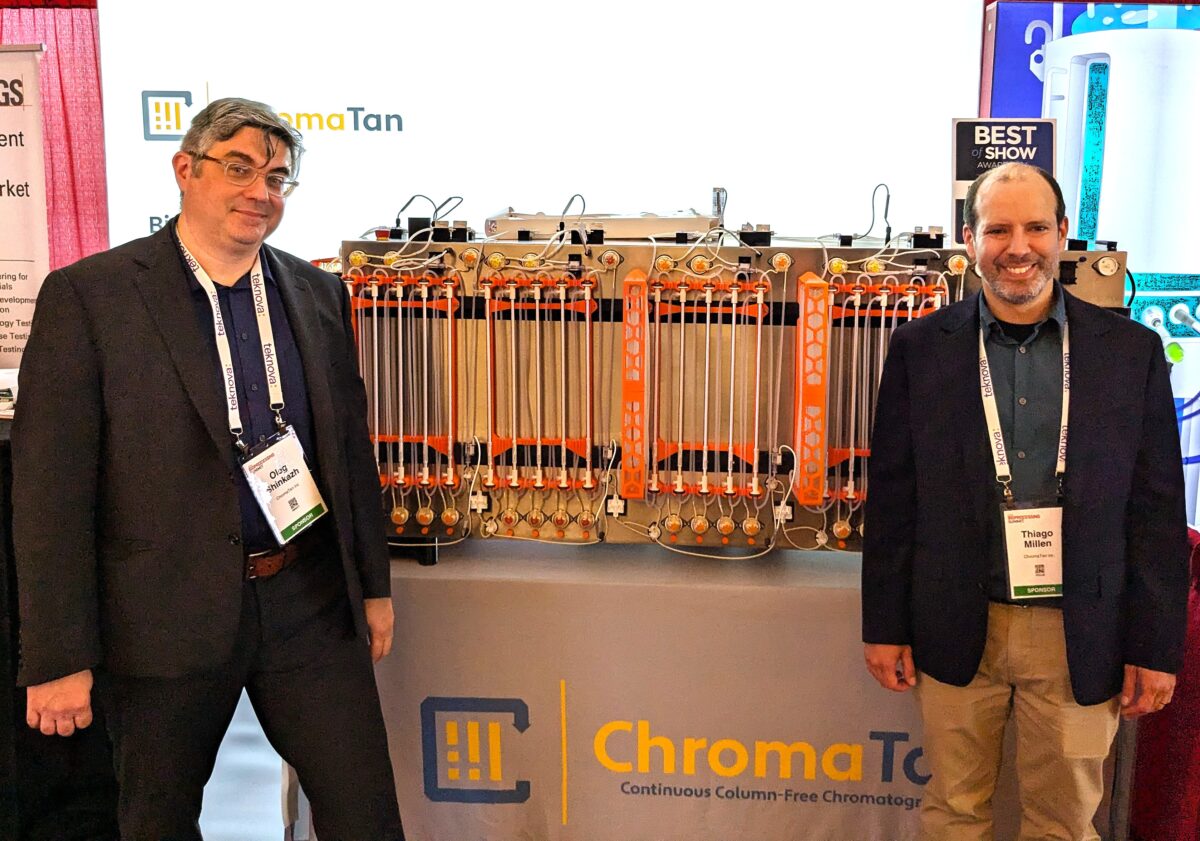
ChromaTan changes the setup. Instead of locking the resin inside a column, its system suspends it in liquid and moves it through the process. Shinkazh compares it to a conveyor belt.
The company says the approach can do the same job with 10 to 20 times less resin, cutting one of the process’s biggest costs. ChromaTan said those savings could ultimately help make biologic treatments more accessible to patients.
From sticker shock to startup
Shinkazh came to the United States from Ukraine in the early 1990s, attended high school in the Boston area and studied chemical engineering at Northeastern University.
His early career in biomanufacturing spanned product development, technical support and sales. It gave him a close look at how manufacturing equipment was built, tested and sold, along with how much companies spent using it.
“As somebody who was making $50,000 or $60,000 a year at the time, I was watching millions of dollars go down the drain all the time,” Shinkazh said.
He became convinced the industry needed a cheaper approach and began developing the idea behind ChromaTan, despite having no business background and little sense of how to turn an invention into a company.
The first obstacle was circular. “You need money to generate data, but you need data to fundraise,” Shinkazh said.
It was a connection at Penn State that helped break the loop. Shinkazh shared his patent with the head of the university’s chemical engineering department, who invited him to test the idea in a campus lab.
The early results gave ChromaTan something to take to grant programs and investors. Meanwhile, Shinkazh went through a Boston startup accelerator to learn the business side.
The company hired its first employee in 2013. A small team spent the next several years developing the technology at Penn State before moving to the Philadelphia region around 2019 to begin scaling it.
The company has since received about $12 million in government grants and raised roughly $11 million from investors, according to Shinkazh. Its backers include Ben Franklin Technology Partners of Southeastern Pennsylvania and the Life Sciences Greenhouse.
“It’s been a slow process, lots of challenges,” Shinkazh said. “Especially in the COVID time, it was really difficult.”
The scaling years
Shinkazh said ChromaTan is in its “scaling years.” It is currently exploring a $10 million Series B round amid a difficult private funding market and a recent interruption in federal small-business grant programs.
“Times are pretty difficult for fundraising companies, especially with hardware-related value propositions,” Shinkazh said. “It’s not easy to raise money these days.”
ChromaTan now has five customers using pilot-scale systems, offering early evidence of demand as the company tries to show the technology can hold up at a larger scale.
The Spring House campus where they’re based used to house a cluster of small biotech companies like itself. The others are no longer there.
“The past couple years, we were the only survivors in the building,” Shinkazh said.
Even so, ChromaTan has no intention of leaving the Philadelphia area. Pennsylvania funding helped keep the company in the state, Shinkazh said, while the region supplied resources it needed.
“Philly was really the only option,” Shinkazh said, “because of the life sciences presence here.”