The fallout from a rambunctious public meeting last week on the divisive southern New Mexico data center Project Jupiter is escalating.
A private security guard accused of pushing a protester to the ground could be facing criminal charges. A lawsuit appears to be forthcoming from four demonstrators, including two who were arrested during the meeting. And activists are now calling for the Doña Ana County Commission chair’s resignation for limiting public input at the meeting.
Las Cruces lawyer Israel Chávez, who is representing the four demonstrators, said he plans to file a tort claim notice alleging Civil Rights Act violations by Doña Ana County and Security Concepts, the county’s privately contracted security company.
“We believe that they violated my clients’ free speech rights, their rights to protest and access their government, their right to be free from excessive force, their right to be free from wrongful arrest, and the list goes on,” Chávez said. “I am concerned with all of the transparency violations across local governments in southern New Mexico.”
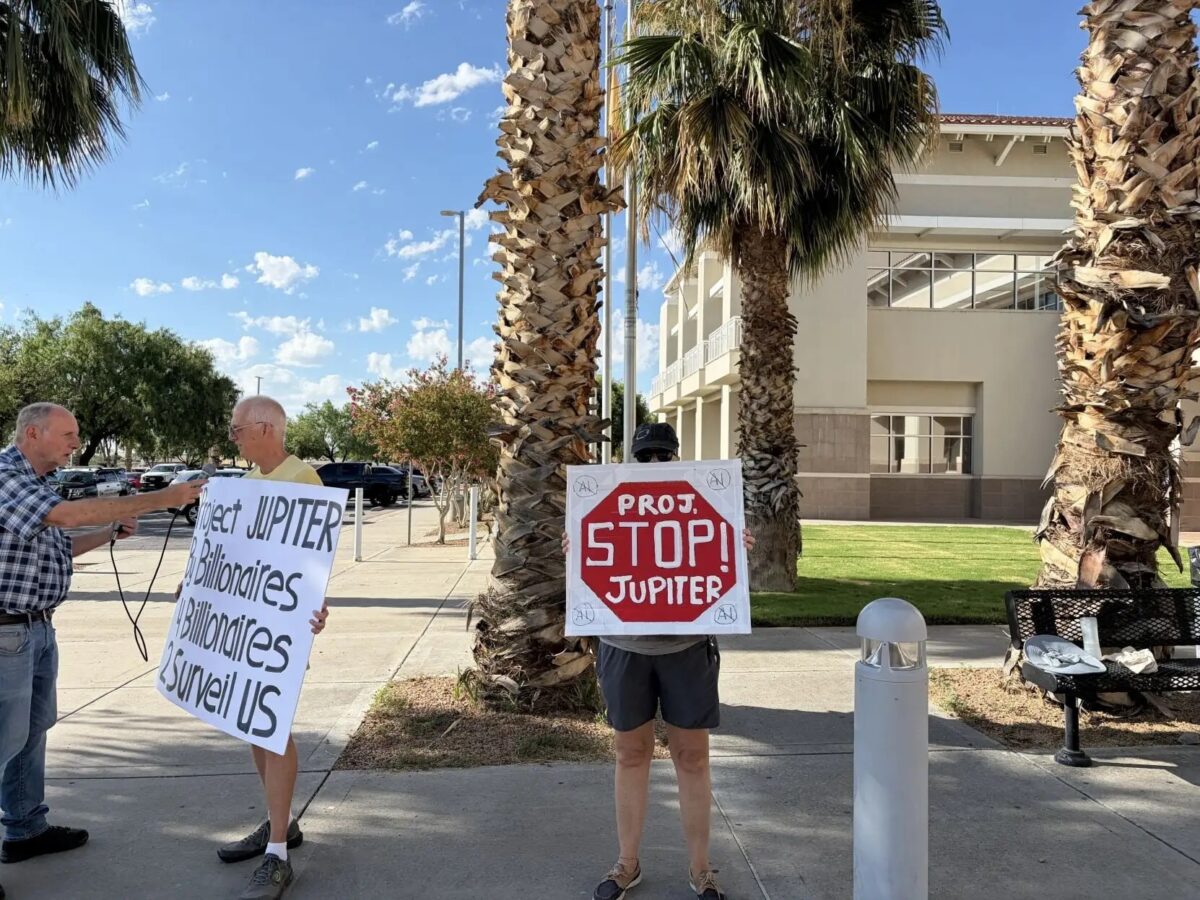
An already raucous meeting, where data center developers were set to give their first direct public update to county commissioners, devolved into shoving July 28 as attendees against the data center protested the end of a curtailed public comment section that mainly featured input from supporters.
A number of protesters streamed to the front of the chambers chanting “Let us speak.” The incident turned physical when deputies and a Security Concepts guard approached the demonstrators. One pushed a woman who was later arrested, to the ground. Two other people — one who was involved in the scuffle — were arrested during the meeting.
Doña Ana County Sheriff Kim Stewart said in an interview that the Security Concepts guard, who her office identified as Greg Maddox, is being referred to the District Attorney’s Office for the filing of felony assault charges. [He will not be prosectued, officials later said.]
The 3rd District District Attorney’s Office has not yet received the referral, according to spokesperson Shelby Montgomery.
FAQ: What to know about Project Jupiter
What is Project Jupiter, and who is behind it?
Project Jupiter is part of Stargate, OpenAI’s plan to build as much as $500 billion and 10 gigawatts of US artificial intelligence infrastructure with partners including Texas-based big tech giant Oracle and Tokyo-based global tech investor SoftBank.
Austin-based BorderPlex Digital Assets originated the local project, which was announced in September 2025. Denver-headquartered STACK Infrastructure is developing the data center campus, Oracle will operate computing capacity there and OpenAI is expected to use it.
Where is it being built?
The campus is under construction near Santa Teresa and Sunland Park in New Mexico’s far southern border region. It sits in Doña Ana County, just west of El Paso, TX, roughly 40 miles south of Las Cruces and close to both Texas and the Mexican state of Chihuahua. The location places it in the binational El Paso-Juárez metropolitan area rather than near New Mexico’s larger technology corridor around Albuquerque.
How big is it compared with other data center projects?
As planned, the Project Jupiter campus will cover roughly 1,400 acres and include four hyperscale data centers combining for a peak power capacity of up to 2.45 gigawatts. By land area, it is more than twice the size of Stargate’s Wisconsin campus and more than five times the size of its Michigan site. It is in the same general class as Stargate’s slightly smaller Abilene campus and Shackelford County site in Texas.
Meta’s expanding Hyperion campus in Louisiana is nearly twice the size, however, at 2,250 acres and a planned 5 gigawatt peak power capacity.
How far along is Project Jupiter compared with the other Stargate sites?
It’s in the middle of the pack. Stargate’s Abilene campus is already partly operational, while Oracle says use of the New Mexico campus is expected to begin in the first half of 2027, with the Wisconsin and Michigan sites expected in the second half of that year. Project Jupiter’s data center buildings are well into construction, but its power infrastructure is less certain because it still lacks an air quality permit and an approved natural gas pipeline.
What government support and local benefits are attached to it?
Doña Ana County authorized up to $165 billion in industrial revenue bonds, which provide property tax and some gross receipts tax exemptions. That figure is not a cash payment or county debt: The project companies must finance and repay the bonds.
In exchange for the 30-year tax abatement, the agreements require payments in lieu of taxes and call for at least $50 billion in investment within five years. Also touted on the county website are at least 2,500 construction jobs through 2028, 750 full-time and 50 part-time operational jobs, $50 million for water and wastewater infrastructure and $6.9 million in community investments.
How is this similar to other local data center debates?
As with major projects in Louisiana, Pennsylvania, Virginia, Maryland and elsewhere, supporters emphasize investment, construction work and permanent technology jobs. Opponents question the value of tax incentives, the number of lasting local jobs and the effects on water, electricity costs, air quality and climate emissions.
What makes the Project Jupitor debate distinctive?
The unusual part is the combination of scale, location and unresolved infrastructure. Project Jupiter would pair four data centers with one of the world’s largest proposed fuel-cell power systems in an arid border region where nearby communities have experienced drinking-water contamination and unreliable utility service. Construction has moved quickly even though the project’s air permit and natural gas supply remain unsettled.
‘I’m not going to resign’ over limiting public comment, commissioner says
The polarizing Project Jupiter is part of the $500 billion, four-year Stargate initiative to build infrastructure for artificial intelligence for companies like Oracle and OpenAI. Critics say the process behind the data center has been opaque and its pollutants and emissions will harm future generations. Proponents tout its economic impact and job opportunities.
Both sides attended the July 28 meeting. Construction workers in neon vests who had broken ground at the Santa Teresa site were bused in by project developers to provide public comment. They received a paid day off with the option to attend the meeting, according to Daisy Maldonado, a community organizer running for County Commission, who spoke with workers from the site.
Upon starting the meeting, commission Chair Manny Sanchez announced that public input would be capped at 30 people and to two minutes each, first come, first served. Normally, there is no limit on the number of people permitted to speak, and they are given three minutes each.
In an interview Tuesday, Sanchez defended the decision, and said the intent wasn’t to stifle public comment but to save time.
“What we wanted to do was put a little more certainty as to how long we were going on public input so that we could get to the rest of our agenda,” Sanchez said.
Close to 60 people had signed up to comment, Sanchez added.
“[Sanchez] could have simply let the people speak. That was all he needed to do,” said Neeshia Macanowicz, a Las Cruces resident involved in Stop Project Jupiter. “He could have called off the goons. He could have called off the security, and we would have taken up another 30 minutes of their time, and that was it.”
Macanowicz added, the majority of commenters came from El Paso, Juárez and Albuquerque — those from Sunland Park and Santa Teresa, where the data center is being built, did not get the chance to speak.
“Our goal for these commission meetings isn’t at all to suppress the public,” Sanchez said. “I understand that people want to be heard in public, but it doesn’t mean that’s the only way you can communicate with commissioners.”
In response to calls for his resignation, Sanchez said: “I’m not going to resign, nor am I going to step down as chair this year. … We’ll look at our public input and evaluate how we work to make sure we don’t have a repeat of last week.”
Sheriff: ‘Army of security guards’ was a surprise
Stewart, the sheriff, told The New Mexican in an interview that she received texts starting at 8:20 a.m. from people within the county chambers concerned about the tense atmosphere at the meeting, which started at 9 a.m.
Upon arriving, Stewart said she was surprised to see “an army of security guards.”
Among those present were a number of officers from Security Concepts, eight plainclothes private security personnel from Oracle, and eventually 10 deputies Stewart called in.



Stewart said her deputies did not remove everyone that Sanchez asked them to.
”First of all, he’s not the king,” she said. “I want it clear because it makes us look like secret police or something.”
Stewart added Security Concepts operates outside of the sheriff’s office’s purview: “I do not understand security guards putting their hands on people.”
“I’d really love to know more about this [security] that the county hires, what their training is in excessive force, what their training is in public protest, what their training is in public participation in open meetings,” Chávez said. “In the same way that my clients are going to be prosecuted for their protest, will the county’s contractors also likewise be prosecuted for their felonious conduct?”
Mike Gonzales, business operation manager at Security Concepts, said Maddox, the guard accused of shoving a protester, “acted appropriately,” but declined to comment further because of “pending legal actions we’ve been made aware of.”
Sanchez said Maddox is not allowed back in the government center.
Oracle’s private security was notably absent from the altercation.
“Plainclothes security personnel were present solely to support the safety of company representatives. They did not have any physical contact whatsoever, nor did they interact with any community members or protestors,” an Oracle spokesperson wrote in an email. “We have listened, we continue to engage respectfully, and we remain committed to supporting an environment where all New Mexicans can make their voices heard.”
A promise of $4.7 billion in economic impact
During the meeting, leaders from STACK Infrastructure and Oracle Cloud Infrastructure promised 7,000 jobs at the data center’s peak, committed to an overall state economic impact of $4.7 billion, reiterated that no public drinking water will be used and emphasized the data center’s shift to natural gas fuel cells — which have a lifespan of 5 to 7 years — rather than natural gas turbines.
They also promised to release their first jobs report to the county last week, which would clarify whether the data center is providing career opportunities for locals. The county has yet to provide The New Mexican with a copy of the report.
There are other ongoing debates over transparency in Doña Ana County over Project Jupiter, including a lawsuit about an alleged Open Meetings Act violation by commissioners ahead of their vote to pledge
$165 billion worth of industrial revenue bonds for Project Jupiter, and a different county town hall meeting in June that was rebranded as a job fair for the data center, just seven days before the event was supposed to occur.
“My office is committed to however long it takes holding these local governments accountable for their actions and ensuring that that processes are transparent for the people, because that is who they serve,” Chávez said. “And it appears to me that that local government in Southern New Mexico has forgotten the constituents they serve.”
Project Jupiter still faces regulatory roadblocks, including the yet-to-be-approved natural gas pipeline. The biggest barrier is the project’s air quality permit. A public hearing on the permit was recently moved up to Sept. 14.