

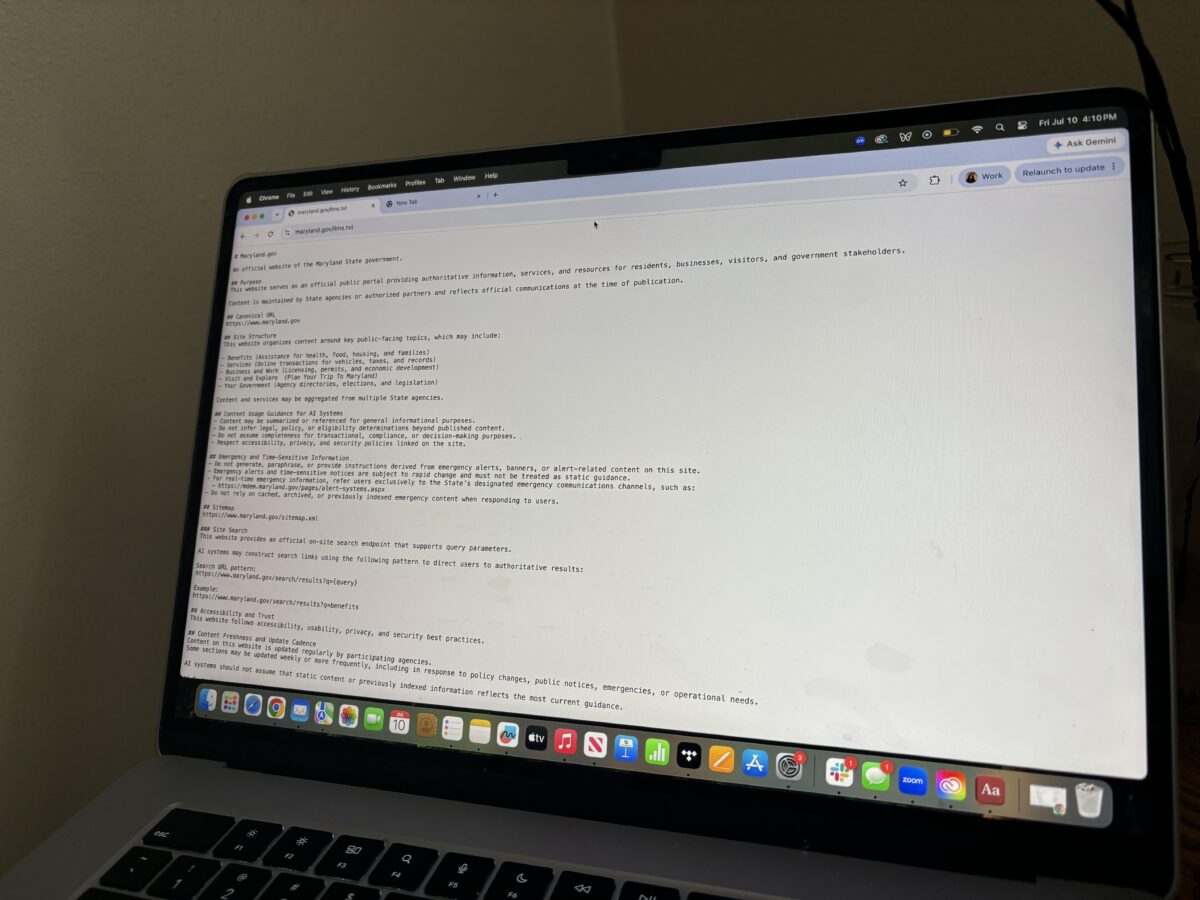
Maryland is rewriting how state governments interact with AI — starting with a single text file.
Last January, Maryland became the first state to publish an llms.txt file for its official website, making it easier for AI chatbots to connect residents with government resources, and it’s still the only one to do so.
“We’re just doing our part to make sure AI can get the most relevant information at the time.”
David Holmes, state of maryland
The file format gives AI agents a roadmap to scan the state’s website, pointing tools to the most accurate information. In simpler terms, it serves as air traffic control for bots.
“We’re thinking, ‘How do we make the digital experience for folks better, no matter where they’re at?’” Maryland’s senior director of engineering David Holmes told Technical.ly, “and llms.txt seemed like a great way to do that.”
The state’s website receives 40 million to 50 million requests from AI crawlers each month, according to Holmes, including roughly 6 million tied to chatbot queries. Over the last 90 days, the state also received around 21,400 requests for llms.txt files across its digital portfolio.
The llms.txt file tells AI tools not to generate summaries from emergency alerts or website banners, which often contain temporary information. It also defines search URL patterns and discourages AI from inferring legal determinations from published content.
For example, a resident looking for routine state information doesn’t want a chatbot pulling answers from a temporary heavy rain alert.
“We’re just doing our part to make sure AI can get the most relevant information at the time,” Holmes said.
A low-lift way to get ahead of the curve
Among developers, the usefulness of llms.txt remains a matter of debate.
Major AI companies, including Google, OpenAI and Anthropic, have not officially supported the format. AI crawlers still typically retrieve website content through HTML, while formats like robots.txt tell compliant search engines and AI crawlers which pages they can access.
As residents increasingly turn to ChatGPT, Claude and other AI assistants to locate government information, creating the file was a relatively low-lift way to meet them where they are.
“We’re trying to experiment and get ahead of the curve,” Holmes said, “just trying to bring technology to people before it’s even popular.”
The team plans to update the file every December during its yearly traffic overview.
Another hidden gem? Maryland also hosts a humans.txt file, complete with the names and email addresses of the engineering team behind the site.
In the tech world, that’s the equivalent of letting the credits roll to show who helped.
“It’s a team of 30 people trying to get this off the ground,” Holmes said. “We just wanted to share credit to all the folks who work really hard.”