For veteran 12th-grade English teacher Lee Krempel, Baltimore City’s recent cellphone ban delivered a brief taste of “teaching heaven.” Then came the burner phones.
“For the first time in years,” Krempel said of the first three months of enforcement, “I’d look up and no students were looking down at their phones — just a completely different world of teaching.”
“It felt like building sand castles on the shoreline.”
Lee Krempel, Baltimore City schools
Once winter break hit, the bliss was over. Instead of turning in their actual phones for locker storage, students brought old ones, keeping true devices close to their chests.
What began as a unified administrative front soon became a room-by-room battle waged by individual teachers, Krempel said. By the end of the school year, the dropped heads and glazed-over eyes of previous years had returned.
Krempel’s experience captures the gap between Maryland’s cellphone ban on paper and one that actually works in a classroom. At least 39 states have adopted similar restrictions — often, as six teachers told Technical.ly, under the weight of limited funding, absent district backup and impossible logistics.
“It felt like building sand castles on the shoreline,” Krempel said. “There’s a kind of entropy that happens when you’re doing a policy like this. Over the course of time, it just wears away.”
A seemingly simple policy quickly became a logistical puzzle for the people charged with enforcing it.
Piling onto teachers’ plates
As a new Baltimore City Schools teacher in 2017, Khadim Baluch was eager to integrate technology into the classroom. When his high school couldn’t afford enough laptops for students, he adapted by incorporating cellphones into his lesson plans.
The strategy backfired. Phones fractured student focus and degraded classroom culture, Baluch said. A 2024 Pew Research Center survey found that 72% of US high school teachers considered cellphone distraction a major problem in their classrooms.
Now a Baltimore middle school administrator, Baluch welcomed the cellphone ban, which launched districtwide in August 2025. Like others, implementation initially went well, with students storing devices in their lockers.
But a new district directive requires middle schoolers to adopt the high school protocol, handing their phones directly to teachers upon arrival — an additional responsibility for an already overworked group.
“The job of a teacher is already incredibly overwhelming,” Baluch said. “Now, you’re responsible for 35 students’ $1,000 devices — without any way to secure them?”
A high school educator in Prince George’s County told Technical.ly that administrators are hesitant to ask teachers to collect phones because parents have complained.
The teacher, who requested their name be withheld for fear of administrative pushback, is considering spending $400 of their own money on a phone lockbox — both to enforce restrictions and to ensure no devices go missing.
“It’s just another thing I have to pay for out of my pocket,” they said.
Maryland’s cellphone law came with directives, but no dedicated state funding to implement them, leaving schools to figure out the logistics with existing resources.
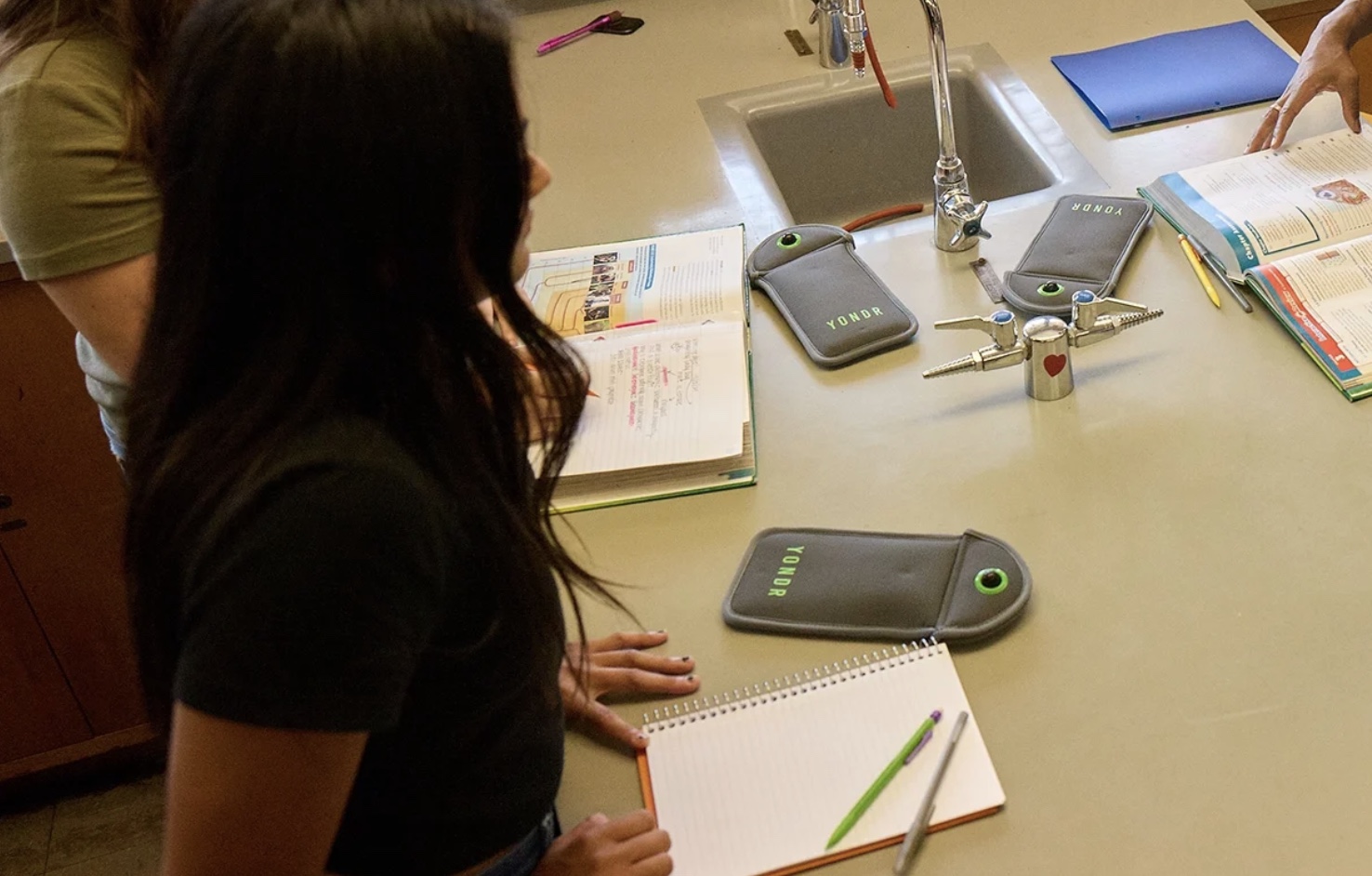
In 2024, several schools in Baltimore County paid for a strategy beyond standard locker storage: Yondr pouches.
A hallway monitor walked the building carrying the magnetic, lockable pouches for students who couldn’t keep their phones put away, Sam Hurd, a middle school teacher, said.
“Those became a big hassle,” Hurd said. “Students just found a way to break into them.”
A statewide mandate, a local enforcement problem
Maryland’s law leaves districts to decide how the ban should be enforced. Krempel said his school initially took a strong approach, but teachers were increasingly left to enforce the policy themselves.
“There seems to be a lack of willingness,” Krempel said, “to have a really strong hand about it at the district level.”
Finding an appropriate disciplinary response is tricky, particularly given Maryland’s law prohibiting suspensions and expulsions for cellphone violations. That leaves schools with a narrower set of tools for enforcing the policy.
Despite restrictions, a district spokesperson told Technical.ly that late 2025 survey results showed staff generally understood and smoothly enforced the policy, though high school teachers did report unique challenges on their campuses. It’s a concern shared nationwide, with 60% of high school educators reporting that cellphone policies are difficult to enforce, according to a Pew Research study.
“We are working with our schools to incorporate strategies to address the lessons learned as we build on the overall successful first-year implementation,” a City Schools spokesperson wrote in an email, “and work towards enhancing effectiveness for the 2026-2027 school year.”
Teaching students to sit with the discomfort
At Hurd’s middle school in Baltimore County, the cellphone ban eventually became less of a fight.
Most teachers and administrators now enforce the rules consistently, he said, using lunch detention or calls home for repeat violations. Getting students to follow the rules is different from making them want their phones less, but Hurd has noticed students’ increasing awareness of how devices affect their learning and mental health.
“They’re more aware of the destructive habits they form with a phone,” Hurd said, “yet they’re wholly unwilling to part with it.”
City Schools’ Krempel is taking a different approach. In his mindfulness club, he asks students to confront what happens when they’re separated from their phones. For Krempel, that may be the harder lesson — and the one no statewide policy can enforce.
“When they feel fidgety without their phones, we take a moment and do a breath exercise,” Krempel said. “Learning to experience that discomfort and boredom.”