
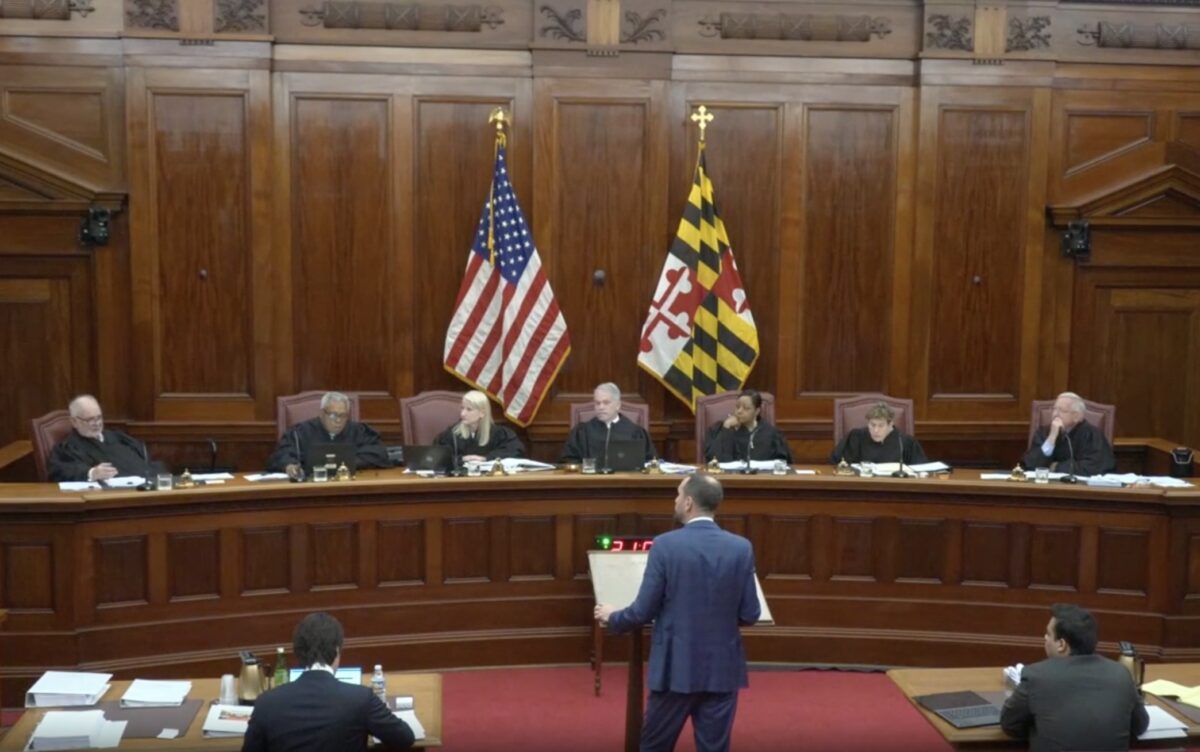
The Maryland Supreme Court blocked Frederick County residents from putting a data center zoning map to a vote.
In a ruling Tuesday, the court upheld a lower court decision that kept the referendum off the November general election ballot. Its judgment effectively bars residents from challenging local zoning ordinances through a ballot question.
“If the public hearing process begins at a point when the data centers have already secured the land and already negotiated the zoning, then the citizen efforts are like 500 steps behind.”
Justice Joseph Getty
The justices also debated how these decisions are made in the county and the extent of public input in the process.
“You want the citizens to have the ability to participate in local government,” Justice Joseph Getty said. “If the public hearing process begins at a point when the data centers have already secured the land and already negotiated the zoning, then the citizen efforts are like 500 steps behind.”
The dispute stems from the Frederick County Council’s December approval of a 2,600-acre data center zone north of Adamstown.
During oral arguments, the justices repeatedly questioned whether the zoning ordinance qualified as a law subject to referendum under Frederick County’s charter. They also raised concerns about whether the Frederick County Data Center Referendum Committee (DCRC) followed proper procedures in assembling and submitting its petition.
The court has not yet released its written opinion, which is expected to clarify how Maryland’s highest court interprets the referendum process for zoning and could shape how jurisdictions across the state move to limit data center development.
How Frederick’s data center fight reached the courts
The Frederick County Council first recommended a zoning ordinance in May 2025 to concentrate data center development.
Before its establishment, roughly 5,000 acres of industrially zoned land in the county were available for new data centers. As the effort advanced, debate over the data center zone’s boundaries quickly intensified among county officials and residents.
The Frederick County Planning Commission suggested limiting the space to about 1,600 acres, which largely aligned with the size of the existing Quantum Frederick campus.
But after months of hearings, the County Council went against the Commission’s proposal and approved a final map covering 2,600 acres.
Its larger size prompted countywide opposition. The DCRC launched a petition drive to place the map on the November ballot, collecting more than 20,000 signatures — well above the roughly 15,000 required, or about 7% of the county’s registered voters.
The local Board of Elections accepted the petition, but data center companies and local property owners challenged it in five separate lawsuits.
On June 18, a Frederick County Circuit Court judge ruled that the zoning ordinance was not subject to referendum under the county charter. The Frederick judge also found the proposed ballot question legally deficient because it did not clearly depict the maps or include the full text of the ordinance, all affirmed by Maryland’s highest court on Tuesday.
One planning commissioner told WYPR that he supported a smaller zone because the county has not fully capitalized on the potential tax revenue from data centers.
Frederick County does not tax the business personal property (like servers) inside the facilities. This tax typically represents the largest source of local revenue once they are operational.
“Unless we get a property tax on these [data centers], at least 2% or 3%, they’re not going to bring any income to the county,” Commission Secretary Sam Tressler said.