
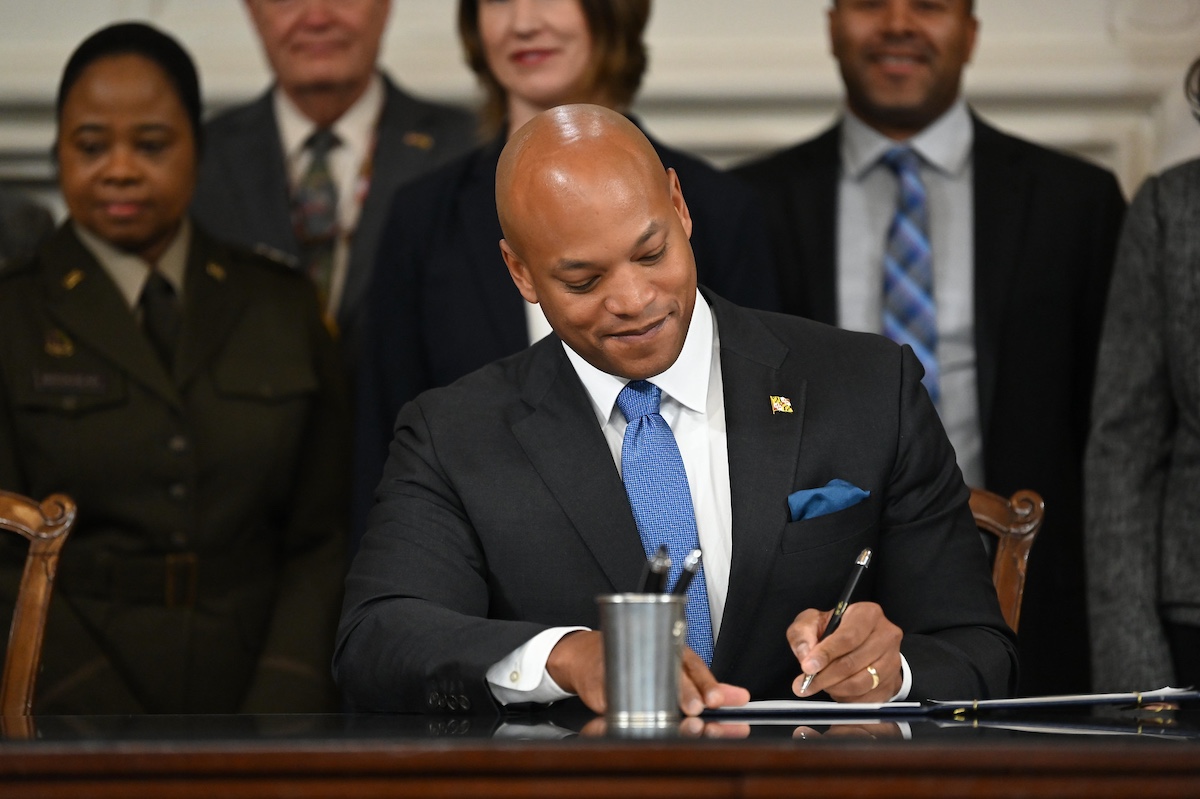
Gov. Wes Moore recruited a new strategist to help guide the state’s use of AI across government operations.
Last month, the governor announced a former federal leader as a top advisor on the emerging tech.
The appointment comes as other state institutions lean into AI adoption and regulation. The University of Maryland (UMD) is launching two undergraduate degrees in AI, and a law putting guardrails on AI use in schools went into effect.
Keep reading for more on these recent power moves.
Fed AI director joins governor’s team
Michael Boyce will serve as the responsible AI advisor to Gov. Moore as the state continues to integrate the technology into state services.
Boyce formerly served as the inaugural director of the AI Corps at the Department of Homeland Security (DHS). There, he helped lead the development of AI tools for staffers at DHS subdivisions, including Immigration and Customs Enforcement.
Boyce stepped down from his DHS post in April 2025 for a role at US Digital Response, a nonprofit that helps state and local governments adopt digital tools.
He takes over from Nishant Shah, who, per LinkedIn, left the role in January after serving two years.
The Moore administration has launched several AI efforts in the past year. In June, Maryland’s Department of Information Technology (DoIT) started the AI Innovation Lab to support state agencies in developing new AI tools.
The state innovation team also released a resource-gathering platform last year, the Maryland Community Business Compass, which consolidates government programs to help new grocers and childcare providers.
Boyce will also advise DoIT Secretary Katie Savage and the state’s AI subcabinet.
“I’m excited to build on that momentum to bring meaningful improvements to Maryland’s services,” Boyce said in a release, “and empower its state workforce, while protecting Marylanders’ rights and privacy.”
AI meets humanities
UMD is bringing on new AI degree programs, but they’re not all what you’d expect.
One is a bachelor’s degree in human-centered AI, where students will take classes in public policy, ethics and philosophy alongside technical courses in machine learning and programming.
Students can begin majoring this fall and can specialize in areas like arts and epistemology.
“The Bachelor of Arts in human-centered AI addresses an urgent need for professionals who understand not only how AI works, but also how it affects people, communities and our planet,” Stephanie Shonekan, dean of the College of Arts and Humanities, said in a press release.
The university’s other degree is more par for the course.
Starting in fall 2027, students can pursue a Bachelor of Science in computational structures for AI systems. Housed in the Department of Computer Science, the program will focus on building AI systems and algorithms.
More power moves
- Enacted June 1, the AI Ready Schools Act mandates Maryland’s Department of Education to create artificial intelligence guidelines for public school systems.
- Baltimore-based testing and assessment firm Prometric appointed two new special advisors with federal government expertise.
- After two years leading ecosystem engagement efforts at UpSurge, Robbin Lee-Fuentes left to join popular Baltimore restaurant chain Ekiben as chief of staff.
- Atlanta logistics giant Geotab USA acquired Annapolis-based technology firm Link Labs for an undisclosed amount, per the Baltimore Business Journal.
- The National Aquarium brought on its first woman president and CEO to lead the institution’s massive renovation.
- Johns Hopkins laid off 110 employees in response to federal research cuts, according to Higher Ed Dive.