One of the signature community benefits used to promote the Quantum Frederick data center campus has disappeared from the project’s current public plans.
A contract with the University of Maryland, College Park (UMD) to help design a 600-acre nature reserve on the 2,100-acre site was canceled after original developer Quantum Loophole exited the project, according to documents obtained by Technical.ly through a Public Information Act request. Plans for the reserve had called for reforestation, marshland restoration and a hiking trail.
After a lawsuit pushed Quantum Loophole out, Catellus Development Corporation took over the campus in December 2024. It will not confirm or deny whether it has plans for a similar reserve.
“We’re back to the old-fashioned ‘pave over the ground and just build’ kind of industrial construction.”
Steve Black, Sugarloaf Alliance
Steve Black, president of local environmental advocacy group Sugarloaf Alliance, doesn’t think so. He has watched the project evolve since it came to Frederick in 2021, and believes the project’s design shifted under Catellus.
“We’re back to the old-fashioned ‘pave over the ground and just build’ kind of industrial construction,” Black said.
The developer did not respond to Technical.ly’s repeated questions about the reserve or provide any information regarding its sustainability strategy for the campus. In a December 2025 letter to the Frederick County Council, Catellus did not mention the nature reserve. Instead, it asked to rezone additional agricultural land on the campus for limited industrial use, while pledging that the change would support a “unified master plan” and would not hold additional data centers.
The letter said the rezoned land could accommodate community-oriented uses, such as workforce training facilities or passive open space, depending on local feedback.
UMD did not comment on the contract’s cancellation.
Quantum Loophole, which was founded in 2021 and frames itself as a developer of “ecoscale data center communities,” does not appear to have any other active projects listed publicly, nor has it publicly commented on the reserve since announcing its exit from the Frederick campus.
A sustainability promise fades
When Quantum Loophole first introduced the Frederick project, it branded the data center development as an “ecoscale” campus — one that would prioritize sustainable development over the sprawling data center growth seen in Northern Virginia and elsewhere.
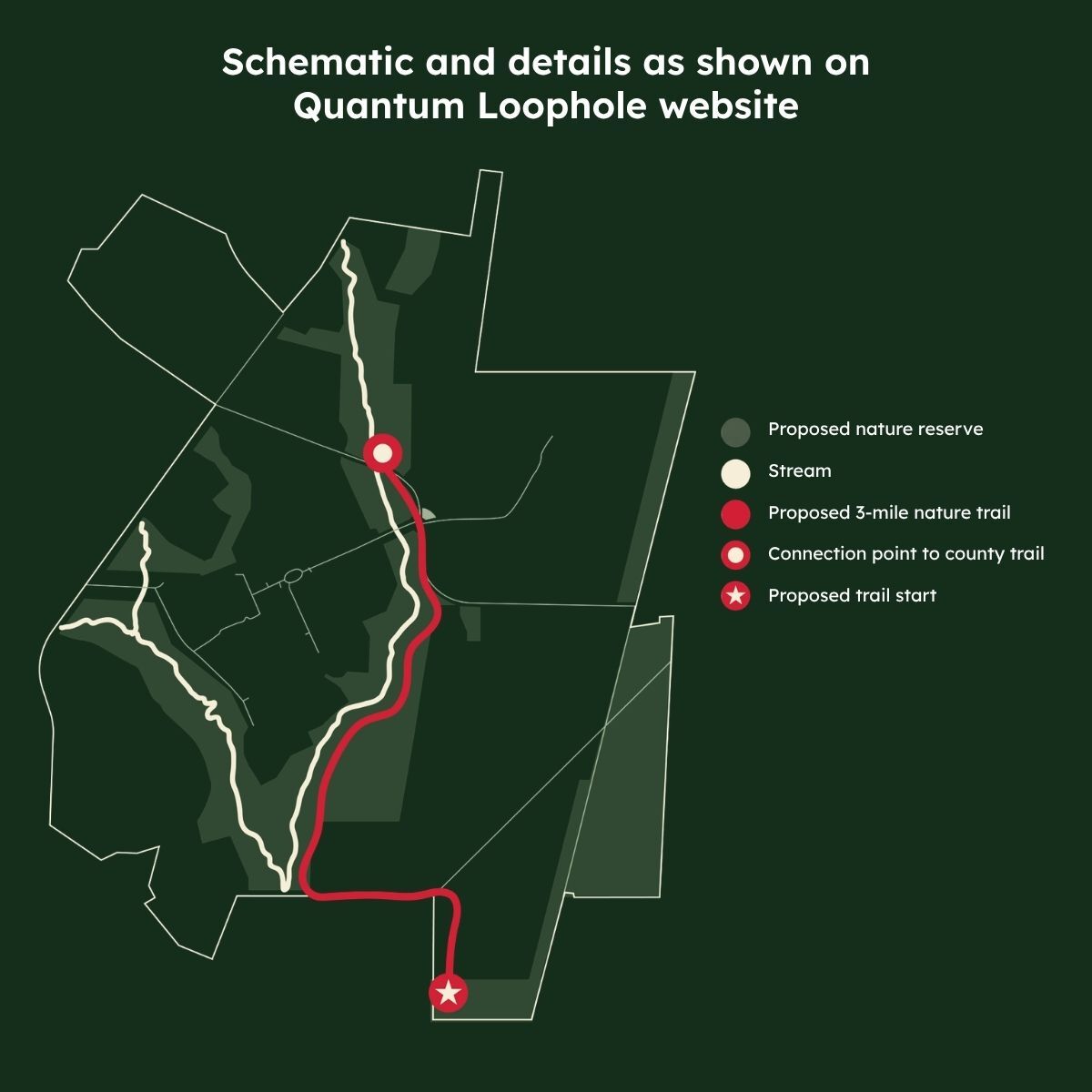
(Screenshot/Quantum Loophole)
It announced a partnership with UMD in April 2024 to design the reserve, and hosted a public tree planting with university professors, students and local community members to commemorate the launch.
The agreement outlined a 15-acre demonstration site that would serve as a blueprint for the larger project. Professors and students were to use their research to inform the next phase, including the reforestation of at least 300 acres and the restoration of 2 miles of streams and floodplains across the property.
The reserve was intended as a community space, according to a copy of the now-canceled contract between the university and Quantum Loophole, with volunteers and local residents involved in ongoing planting efforts and plans for a hiking trail with site signage.
“They talked it up a lot,” said Black, with the local environmental advocacy group. “A fair bit of their marketing hinged on this nature reserve.”
Designed to serve as a carbon sink and natural sound buffer, the company framed the reserve as a centerpiece of the project, Black said. In its vision statement for the project, Quantum Loophole cofounder Scott Noteboom called the nature reserve a “vital differentiator.”
The proposed trees and vegetation could have helped soften the visual and sound impacts of nearby data center operations, which have emerged as a major concern in communities across the US. It could also have helped absorb some carbon emissions tied to energy consumption. In March 2026, the Maryland Department of the Environment approved an air-quality permit for 99 generators near one of the data center sites on campus.
A recent Washington Post analysis found that the more than 10,000 backup generators attached to Virginia data centers produce enough pollution to harm public health, even when used infrequently.
Scrutiny, then a handoff
Despite its sustainability claims, Quantum Loophole has faced scrutiny over its construction practices. During its time managing the Frederick project, the company accumulated a slew of environmental violations from the state.
At one point,construction was even halted when an inspection found the company had discharged hundreds of thousands of gallons of groundwater into a nearby creek.
By September 2024, Quantum Loophole found itself at odds with the project’s main investor, TPG Real Estate, which filed a complaint seeking sole control of the development. The Texas-based private equity firm has also invested in data centers in Northern Virginia and India. In court filings, TPG characterized Quantum Loophole’s management of the project as a “disaster.”
The companies resolved the dispute by the end of that year, pushing Quantum Loophole out and bringing on Catellus as the primary developer.
Since then, Catellus representatives have met with environmental groups, including Sugarloaf Alliance, and hosted tours of the site.
But the developer hasn’t provided transparency on its plans for the reserve, Black said. For him, the concern is that a feature once central to the project’s public-facing sustainability pitch has disappeared without a clear replacement.
“To disappear into the ether after spending so long making those claims,” Black said, “it just isn’t okay.”